SpaceX ($SPCX) has committed roughly $19.6 billion in cash and stock for about 65 MHz of nationwide US mid-band spectrum from EchoStar. The line of business that spectrum exists to unlock booked $0 in the June quarter, and on our model it books $0 for six more quarters after that.
That contrast is the whole reason the deal gets written about, and on its own it is not an argument. Spectrum is a permanent licensed input bought at a scarcity price; comparing an acquisition price to a first-cohort revenue line would make any licensed asset look absurd. The question worth asking is the inverted one, and our model can answer it directly: what does the business this spectrum unlocks have to become before $19.6 billion is an ordinary capital decision?
The answer is 23.2 million monetised handsets by mid-2031 — against the 74.3 million our model already assumes, and against roughly 22 million monthly actives the free messaging service touches today.
One provenance note before anything else. The consideration is reported in a $17–19.6 billion range depending on whether the AWS-3 amendment is included and how the SpaceX stock component is valued, and the definitive figure needs closing documents nobody outside the two companies has. Every number in this piece uses $19.6 billion, the top of the range, because that is the conservative end for the argument being made. At $17 billion the break-even falls to 20.1 million handsets.
What is actually established
- The FCC approved the SpaceX–EchoStar assignment on May 12, 2026, subject to a $2.4 billion escrow tied to claims arising from EchoStar's abandoned terrestrial 5G buildout. The escrow is a seller-side condition; it is not counted in the price above.
- The spectrum is about 65 MHz nationwide: AWS-4 (~40 MHz), the H-block (~10 MHz) and unpaired AWS-3 (~15 MHz). It is technology-neutral, with buildout conditions — usable from orbit, from towers, or both.
- EchoStar's parallel AT&T sale closed in July 2026 at about $23 billion for roughly 50 MHz, taking its total spectrum monetisation past $40 billion.
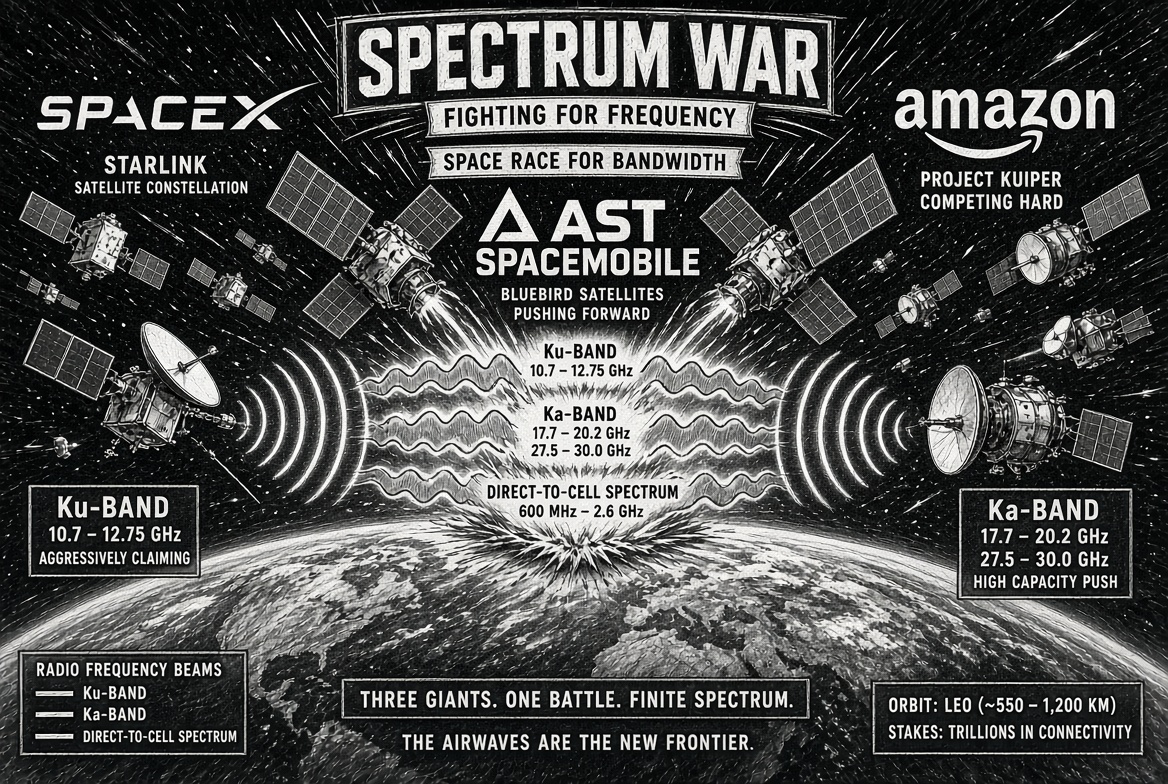
- AST SpaceMobile has FCC authorisation for up to 248 satellites for direct-to-device service, on partner carriers' low-band spectrum. It is a real competitor for the same handsets, and now a tracked ticker here ($ASTS) — though we carry no forward model for it, so its scale can be described but not priced.
- The "$6 billion for 800 MHz" item circulating today is not a transaction. It is reported early-stage interest — SpaceX and AST SpaceMobile among parties looking at low-band spectrum held by Grain Management, with preliminary offers expected in the first week of September and the FCC wanting the process concluded by November 5, 2026. Elon Musk has publicly replied "Not true" to a post carrying the report of SpaceX's interest. No figure in this piece includes it, and it should not be quoted as a price until something is signed.
The first denominator: what a megahertz cost
$19.6 billion for 65 MHz is $302 million per MHz of nationwide licence. AT&T's closed purchase from the same seller was $23 billion for about 50 MHz, or $460 million per MHz.
Both are nationwide, so the population denominator is identical and the comparison is clean in a way most spectrum comparisons are not. SpaceX paid about 66% of what AT&T paid per megahertz, for spectrum in a band range that a terrestrial carrier would find harder to use and a satellite operator finds easier.
That is the first thing the coverage of this deal has not supplied, and it points the opposite way from the headline number.
The second denominator: what it cost against SpaceX's own quarter
Against the June quarter:
- 2.51 quarters of total company revenue ($7,814M).
- 1.07x a full quarter of consolidated capex ($18,369M) — though that quarter's capex was 86% AI infrastructure.
- 14.3x the Connectivity segment's quarterly capex ($1,367M), which is the segment the spectrum actually belongs to.
- 2.96 years of the Connectivity segment's operating income at the June rate ($1,656M a quarter).
The last two are the ones that mean something. Set against the business it joins rather than against a consolidated capex line dominated by data centres, this is a large purchase — roughly three years of everything the connectivity business currently earns.
The reconciliation: what our model already pays for this
Our SPCX model splits Connectivity into two verticals, and Starlink Mobile exists specifically to carry the enhanced direct-to-handset tier. Its thesis names the two preconditions outright — the V2 Mobile satellites and the EchoStar spectrum — and it is held back six quarters before any revenue starts, so the first sellable quarter is 2028 Q1. Today's messaging service is not in it; that sits inside Starlink, where it already earns money.
So the model has already bought the thesis this deal is the input to. What it has never done is price the input.
Run the model with the vertical and without it. The difference is what our own assumptions say the enhanced tier is worth:
| Base case | |
|---|---|
| Fair value with Starlink Mobile | $187.12 |
| Fair value without it | $182.34 |
| The vertical's equity value | $63.0B |
| Per share | $4.78 |
| Spectrum cost as a share of it | 31.1% |
The model says the thing costs 31 cents on the dollar of what it unlocks. That is the finding, and it is the reverse of the framing the deal usually gets.
Two things must be said immediately, because they are what makes that number soft.
First, about 97% of the $63.0 billion is the exit multiple. The vertical's discounted free cash flow across the explicit five-year window is $1.80 billion; the rest is 20x revenue applied to a terminal year that starts from a revenue line which does not exist yet. This is our assumption, not a disclosure, and the model's own valuation note says to treat fair value as a function of that multiple first and everything else second.
Second, the model's first sellable quarter is $37.4 million, not the $18 million a subscriber-times-price sketch produces. The driver's net adds glide from 1 million toward a 9 million ceiling before the first quarter closes, so 2028 Q1 opens with 2.06 million monetised handsets rather than one. It is our number either way, and it is small either way.
Break it, and it still clears
Run the vertical's value with one assumption broken at a time. Every stress we could defend leaves it above what the spectrum cost:
- At a 14x exit multiple — what the current share price implies, rather than the 20x the model carries — the vertical is worth $44.5B.
- At the bear case's 10x, it is worth $32.2B.
- At $3 ARPU instead of $6 — the halved wholesale price the model's own notes name as the load-bearing risk in this vertical — $31.5B.
- If V2 Mobile slips 18 months, pushing first revenue to 2029 Q3, $23.6B.
The break-even is where those stresses converge: the vertical is worth exactly $19.6 billion at 23.16 million monetised handsets by 2031 Q2, which is 2.6% of the 900 million handset TAM the model assumes, against the base case's 8.25%. Equivalently, holding the subscriber path and breaking price instead: break-even ARPU is $1.87 a month against the $6.00 assumed.
Put the subscriber figure next to the one real datapoint that exists. The ~22 million monthly actives on today's free messaging tier, disclosed at the August all-hands, is a number of handsets that already use a SpaceX satellite for something. The spectrum pays for itself if the paid tier eventually monetises about as many handsets as the free tier already touches — five years from now, at under two dollars a month.
Whether that happens is a carrier-packaging question, and carriers set the price. But it is a far lower bar than the deal's headline number implies, and stating the bar is more useful than pricing the option.
What the model does not carry, and will not after this piece
Four gaps, each deliberate:
- The $19.6 billion outflow is not in the model. It is the purchase of a permanent licence, not an operating cost, and this model projects revenue, EBITDA and capex — it has no balance sheet line for an acquired intangible. The vertical's own capex intensity (140%, gliding to 25%) is satellite spend, not spectrum.
- The shares issued to EchoStar are not in the share count. If as much as $11.1 billion of the consideration settles in stock, then at the $146.23 price basis our model carries, that is roughly 75.9 million shares — 0.58% of the 13.176 billion the model uses, and worth about −$1.07 a share. Against +$4.78 for the vertical it buys. Both figures are ours, and the stock component's real valuation basis is not public, so treat the dilution as an order of magnitude rather than a number.
- Direct retail on this spectrum remains unmodelled. It is named in the vertical's streams and explicitly carried at zero. Technology-neutral licences with buildout obligations permit a hybrid terrestrial network; if SpaceX builds one, none of it is in the $63.0 billion above.
- The escrow is EchoStar's problem, not SpaceX's, on the facts as approved. It stays out of the price.
What to watch
- The closing documents. The cash-versus-stock split, how the stock was valued and when, and whether the AWS-3 tranche has closed. Two "up to $8.5B" ceilings and a "$2.6B in stock" are not a price, and the share count is the part that touches our model.
- V2 Mobile's launch date against the end-2027 target. The entire six-quarter delay in our model hangs on it, and Starship cadence is the gating input. Each two-quarter slip costs the vertical $12–15 billion of value on the run above.
- The first wholesale ARPU any carrier discloses. $6 a month is ours, it is the assumption the vertical's value is most sensitive to, and one carrier disclosure would replace it with a fact.
- Whether the Grain 800 MHz process produces a signed transaction, at what price, and to whom. Preliminary offers are expected in early September. If SpaceX wins it, this article's denominator changes; if AST does, the competitive picture does.
- AST SpaceMobile's buildout against its 248-satellite authorisation. It is chasing the same handsets on carrier spectrum rather than owned spectrum, which is the strategic difference this deal was about.
The other two ways to reach a handset
The EchoStar purchase only reads as expensive or cheap next to what the alternatives cost, and this week supplied both of them.
AST SpaceMobile is renting, and now bidding. Its route to a phone has always been carrier low-band — 700, 800 and 850 MHz held by AT&T and Verizon and lent to the satellite — which is why its satellites are built for cellular interoperability rather than for a band it owns. The Grain Management block changes the shape of that. Grain took T-Mobile's 800 MHz portfolio this month in exchange for its own 600 MHz holdings and about $2.9 billion in cash, and the FCC cleared the swap on the condition that Grain go and find someone to build on the spectrum rather than sit on it. AST is not a spectator to that process: in mid-August it received Special Temporary Authority to test on the exact frequencies at issue — 817–824 MHz uplink and 862–869 MHz downlink, with up to 100 commercial handsets, non-commercial and controlled. That is a company with satellites already in orbit that can work in the band, testing it while the block is for sale.
The number to hold onto is what the block would cost per megahertz. Grain's reported target is around $6 billion. T-Mobile's 800 MHz portfolio is generally described as roughly 10 MHz of nationwide low-band, and if that is the size of what is on offer, the ask is about $600 million per MHz — roughly twice the $302 million SpaceX paid for mid-band and above the $460 million AT&T paid. The block size is not something we can establish from the public record, so treat that as conditional arithmetic rather than a comparison. But the direction is not in doubt: low-band propagates better and costs more per megahertz, and 65 MHz of mid-band bought at 66% of the terrestrial clearing price starts to look like the cheaper way to buy reach if you have satellites large enough to make up the link budget. That trade — buy more megahertz at a worse frequency, and spend the difference on aperture — is the actual strategic content of the EchoStar deal, and it is why the six-quarter V2 Mobile dependency in our model is load-bearing. The spectrum is only cheap if the satellite is big.
Amazon is buying the frequencies rather than the licences. Amazon ($AMZN) has taken a third route: an announced acquisition of Globalstar at roughly $11.5 billion, under review and expected to close in 2027, which brings dedicated mobile-satellite service spectrum at 1.6 and 2.4 GHz with global authorisations attached — the same allocation behind the emergency satellite messaging already shipping on iPhones. In late July it filed with the FCC for a dedicated direct-to-device constellation of up to 5,105 satellites on that spectrum, with deployment targeted around 2028. Separately its broadband constellation is behind: the FCC waived the mid-2026 half-deployment milestone in June but attached a temporary loss of spectrum priority against earlier-round systems, with the full-deployment deadline still 2029.
None of that D2D programme is in our AMZN model. That model carries Amazon Leo as a broadband subscription line — the 3,236-satellite licence, held at zero revenue across every historical quarter, opening in 2027 Q1 at $70 a month and reaching roughly 11 million subscribers by 2031 in the bull case. There is no Globalstar line, no MSS spectrum, no handset revenue and no $11.5 billion outflow anywhere in it. That is a gap we are naming rather than filling, on the same rule that keeps the $19.6 billion out of the SPCX model: an announced acquisition that has not closed is not a driver.
So the three approaches, priced the only way each can be:
| How it reaches a phone | What it paid | What is in our models | |
|---|---|---|---|
| SpaceX | Owns 65 MHz of mid-band outright | $19.6B, ~$302M/MHz | Starlink Mobile, $0 until 2028 Q1 |
| AST SpaceMobile | Rents carrier low-band; bidding on Grain's 800 MHz | Nothing yet; ~$6B asked | Tracked, but no forward model |
| Amazon | Buying dedicated MSS spectrum via Globalstar | ~$11.5B announced, not closed | Leo broadband only; no D2D |
Read across that row and the argument of this piece gets sharper rather than softer. SpaceX is the only one of the three that has already paid, already been approved, and already owns the input — and it is the only one whose direct-to-handset business a published model on this site can put a number on. Amazon's is an acquisition awaiting a regulator. AST's is a bid that has not been made, on a block that has not been sized, against a seller running to a November deadline. The competitive risk to SpaceX is real and it is mostly about price: another well-funded bidder in the Grain process is the difference between a negotiation and an auction, and every subsequent block of low-band gets more expensive for everyone. But the assets that would answer it are years and one regulatory approval away from earning anything, which is precisely the criticism being made of the deal we just priced.
What kind of asset this is
The reason $19.6 billion for a 2028 revenue line is not obviously mad has nothing to do with SpaceX and everything to do with what a spectrum licence is. Exclusive mid-band is non-depreciating, cannot be manufactured, cannot be bought twice, and is priced by scarcity rather than by the cash flow of its first cohort of users. Everyone else chasing direct-to-device — AST, the Lynk and Omnispace combination, Globalstar — either rents capacity from carriers or holds narrow mobile-satellite allocations. Owning 65 MHz outright is the one part of this business that cannot be replicated by launching more hardware. We covered the physics and the licensing machinery behind that separately, in our guide to satellite spectrum.
What our model can say is narrower and more checkable than any of that: on the assumptions we have already published, this purchase clears its own bar at under a third of the subscriber count we were already assuming. If it fails, it will not be because the price was wrong. It will be because the carriers never packaged it, or because V2 Mobile was late.
The $19.6B consideration, the $17–19.6B reported range, the ~65 MHz composition (AWS-4 ~40 MHz, H-block ~10 MHz, unpaired AWS-3 ~15 MHz), the May 12, 2026 FCC approval, the $2.4B escrow and its tie to EchoStar's abandoned terrestrial buildout, the ~$23B / ~50 MHz AT&T close in July 2026 and the >$40B total monetisation, AST SpaceMobile's 248-satellite authorisation, its mid-August Special Temporary Authority to test 817–824 and 862–869 MHz on up to 100 handsets, the Grain Management 800 MHz process — the T-Mobile swap for Grain's 600 MHz plus ~$2.9B cash, the FCC's find-a-partner condition, early-September preliminary offers, the November 5, 2026 deadline and the ~$6B reported target — Elon Musk's "Not true" reply to the report of SpaceX's interest, and Amazon's ~$11.5B Globalstar acquisition, its late-July filing for up to 5,105 direct-to-device satellites on 1.6/2.4 GHz and the June waiver of its Leo deployment milestone are all from FCC orders and public reporting, not from any dataset this site stores; they are stated as of August 21, 2026, and the consideration in particular is a reported range rather than a disclosed price. The $302M and $460M per-MHz figures, the 66% ratio, the 2.51 quarters of revenue, 1.07x consolidated capex, 14.3x Connectivity capex and 2.96 years of Connectivity operating income are R40 arithmetic on that reported consideration and on the disclosed 2026 Q2 figures — revenue $7,814M, capex $18,369M, Connectivity revenue $4,291M, Connectivity capex $1,367M, Connectivity operating income $1,656M. Everything from the reconciliation onward is our model and is an assumption, not a fact: the $187.12 base fair value, the $182.34 without the Starlink Mobile vertical, the $63.0B and $4.78-a-share difference, the $1.80B explicit-period PV, the 2028 Q1 start and its $37.4M first quarter, the 74.3M terminal subscribers, the $6.00 ARPU, the 900M TAM, the 20x exit multiple and the 11% discount rate all come from our model as of August 19, 2026. The stressed figures — $44.5B at 14x, $32.2B at 10x, $31.5B at $3 ARPU, $23.6B on an 18-month slip — and the 23.16M / $1.87 break-evens are that same model re-run with one assumption changed, solved to the point where the vertical's equity value equals $19.6B. The ~22M monthly actives on today's messaging tier is quoted in the model's own notes from the August 2026 all-hands and is a claimed figure, not a filed one. The 75.9M share dilution estimate assumes $11.1B of stock consideration valued at the $146.23 price basis our model carries as of the August 18 close, which is not how the stock component was actually priced — it is an order of magnitude, and the real figure needs the closing documents. The ~$600M per MHz for the Grain block is R40 arithmetic on a reported target price and a block size we could not verify — it is conditional on that ~10 MHz and should not be quoted as a valuation. The Amazon Leo figures — the 3,236-satellite licence, the 2027 Q1 start, the $70 monthly price and the ~11 million bull-case subscribers by 2031 — are our AMZN model and are assumptions; that model carries no Globalstar line and no direct-to-device revenue at all. Globalstar is not a tracked ticker here and AST SpaceMobile carries no forward model, so nothing about either is priced by us. Nothing here is a claim that SpaceX has sold, or will sell, a single direct-to-cell subscription.