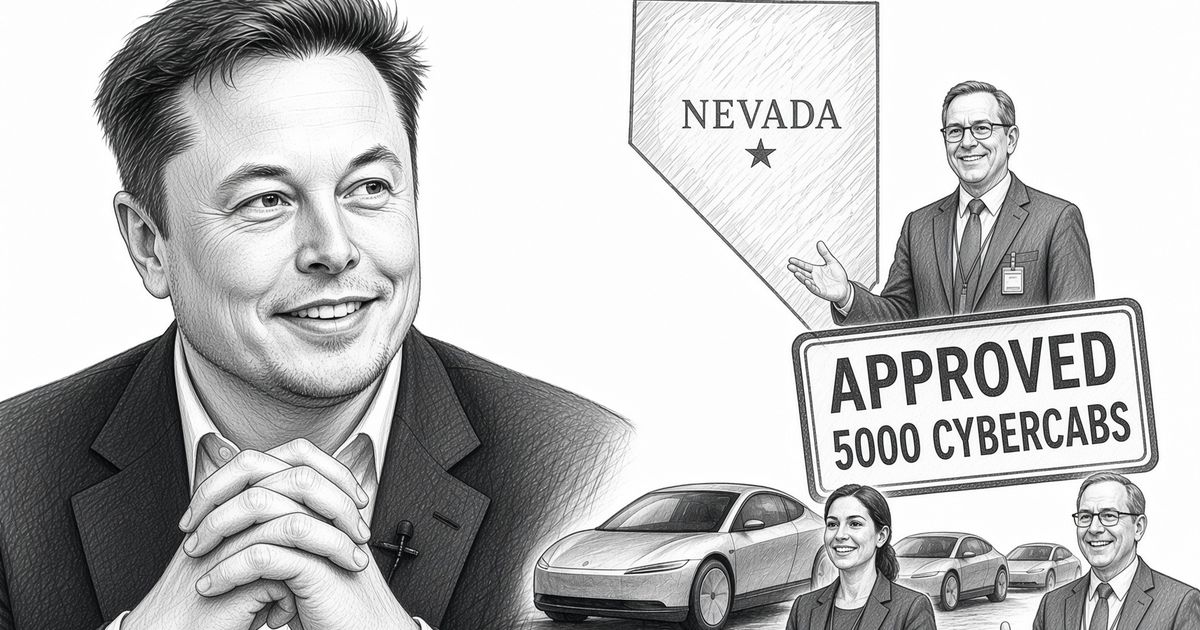
The Nevada Transportation Authority unanimously approved three autonomous vehicle network company permits on Thursday, August 20: Tesla up to 5,000 robotaxis, Waymo up to 1,000, and Uber up to 1,000 to be run through its Motional and Zoox partnerships. Together that authorises up to 8,000 robotaxis in Clark County over the next twelve months, on top of the 100-vehicle permit Zoox already holds.
For Tesla it is the whole ask. The company applied in early June for up to 5,000 vehicles across Clark County; an interim order on July 27 let it operate ten, capped at 45 mph and confined to the Strip, while the staff investigation ran. That investigation concluded, the Authority voted, and the ten-car restriction is no longer the operative limit.
So this is a win, it is unambiguous, and it is the largest robotaxi permit any US regulator has issued to Tesla. The rest of this piece is about what it is worth, which is not much, and why the reason it is not much came from Tesla's own witness at the same hearing.
What the permit is worth on our model
Our Tesla model carries robotaxi as a capacity line: 1,000 vehicles in commercial service at the June quarter, additions of 600 a quarter beginning in the December quarter, compounding at 22% a quarter, at $30,000 of revenue per deployed vehicle per quarter and 45% utilisation gliding to 72%. Every one of those is our assumption; none is a Tesla disclosure.
Here is what the news moves, against a base case of $272.39 and a price of $351.12 at the August 19 close:
| Change to the base case | Fair value moves | Share of the $272.39 base |
|---|---|---|
| Starting fleet 1,000 → 5,000, the full permit | +$0.33 | 0.12% |
| Starting fleet 1,000 → 2,500 | +$0.12 | 0.04% |
| Starting fleet 1,000 → 10, the July interim cap | −$0.08 | 0.03% |
| Quarterly additions 600 → 1,200 | +$8.38 | 3.08% |
| Additions growth 22% → 30% | +$11.06 | 4.06% |
| Additions growth 22% → zero | −$7.40 | 2.72% |
| The entire robotaxi line switched off | −$8.47 | 3.11% |
Granting Tesla five thousand cars instead of one thousand is worth thirty-three cents a share. Eight basis points of the base case. The distance between the July cap and the August permit — a 500× swing in what a regulator will allow — spans forty-one cents in total, from −$0.08 to +$0.33.
Eight percentage points on the rate those cars are added at is worth $11.06, or thirty-three times the entire permit. That is the arithmetic of a compounding line: the level you start from is a rounding error against the rate you compound at, and a permit sets a level.
Tesla's own engineer said the ceiling was never the constraint
This is the part that makes the number honest rather than merely deflationary, and it did not come from us. Eric Early, Tesla's Cybercab chief engineer, told the meeting:
"The 5,000 has always been a ceiling for us. I don't think we'll be in a position by this time next year to deploy 5,000 vehicles, and it's not [because of] the technology. … I think we would be extremely happy and satisfied if we could get ourselves up to 2,500, maybe maybe a bit higher than that in the next year."
Read that against the permit. Tesla asked for 5,000, received 5,000, and its own Cybercab chief engineer said in the same session that half of it would be a satisfying outcome. The binding constraint on Nevada is not the Authority. It is Tesla.
And 2,500 is the number our model should be measured against, because it is the only forward figure in this story that came from the company rather than from a regulator or from us. Our model's fleet reaches 4,315 vehicles by the September 2027 quarter — nationally, across every market. Tesla's own aspiration for Clark County alone, over that same twelve months, is 2,500.
Those two numbers cannot both be comfortable. Either Nevada is about to be 58% of Tesla's entire national robotaxi fleet, which would be a remarkable concentration in a county of 2.4 million people, or our national ramp is too low, or Tesla's Nevada hope is. The model's 22% additions growth is the input that resolves it, and it is worth $11.06 a share — more than the entire robotaxi line is worth today.
The county is now a four-way race
The same vote authorised the competition, and the totals are worth putting side by side:
| Operator | Vehicles authorised | Notes |
|---|---|---|
| Tesla | 5,000 | The full June application |
| Waymo | 1,000 | Over the next year |
| Uber | 1,000 | Run through Motional and Zoox partnerships |
| Zoox | 100 | Pre-existing permit; charging fares since August 10 |
Tesla holds 62% of everything Clark County has authorised, which is the strongest single statement of regulatory confidence in this story and cuts directly against the reading — ours included, until yesterday — that the July ten-car order signalled something adverse about Tesla specifically. It did not. It was an interim order pending a staff investigation, and the investigation ended in the full ask.
Against our robotaxi fleet math, where roughly 14,800 cars move Tesla's revenue by 1% and about 7,000 buy a penny of quarterly EPS, the whole county's 8,000-vehicle authorisation — every operator, not just Tesla — is 54% of the fleet that would move Tesla's revenue a single point. Tesla's own 5,000 is 71% of a penny of quarterly earnings. Las Vegas is a proving ground and a competitive battleground; on these numbers it is not yet a financial event.
Not everyone at the hearing agreed it should have happened. Kimberly Maxson-Rushton, representing the Livery Operators Association, argued the approvals go too far too fast: "These applications raise two grave concerns. One deals with the oversaturation of the commercial transportation industry as a whole in Nevada. And the second one deals with the overcrowding of the roadways, and specifically the Golden Triangle." Local taxi operators opposed all three permits. They lost unanimously.
Does the model change
Not in the fleet count, because the fleet count is worth thirty-three cents, and not in the additions rate, because one county's permit is a ceiling rather than a delivery.
What does change is a rationale string, and it is the one this news actually speaks to. Our model's justification for 22% quarterly additions growth reads, in as many words: "Geofence expansion, not the production line, is what gates this early." Nevada was the first documented test of that claim, and the claim did not survive it. The geofence expanded to the full ask, in the largest permit Tesla has been granted anywhere, and Tesla's chief engineer immediately said the company could not fill it — explicitly "not [because of] the technology."
If permission is not the gate and technology is not the gate, then the gate is deployment: building, shipping, charging, cleaning and supporting the cars. That is a different assumption with a different shape, and it belongs in the model's own words. We are changing the reasoning, not the number — the number stays at 22% until something other than a ceiling moves it.
What to watch
- How many cars Tesla actually puts on Nevada roads by the December quarter. The permit allows 5,000; the company guided to 2,500 in a year and said it would be happy with that. Anything under a few hundred by year end says deployment, not permission, is the constraint — and confirms the rationale change above.
- Whether paid service starts inside the thirty days the company indicated it needs for vehicle inspections, insurance filings and rate schedules. Zoox went from permit to fares on the same Strip; the gap between authority and revenue is the cleanest available read on operational readiness.
- Whether the Nevada cars are Cybercabs or retrofitted Model Ys. Our Cybercab ramp piece turns on the distinction, and its base case put only a token count in Las Vegas by December — a call this permit does not yet overturn.
- What Waymo does with its 1,000. It is the control experiment: same corridor, same regulator, same twelve months, a company that has been deploying commercially for years. If Waymo fills its allowance and Tesla does not, that is a deployment-capability finding rather than a regulatory one.
- Whether the "oversaturation" objection returns as a condition. The Livery Operators Association lost this vote. Eight thousand authorised vehicles in one county is the kind of number that invites a second look, and permit conditions are where that would appear.
The August 20, 2026 Nevada Transportation Authority vote, the unanimous approval of three autonomous vehicle network company permits, the 5,000-vehicle Tesla authorisation, Waymo's 1,000, Uber's 1,000 through its Motional and Zoox partnerships, the roughly 8,000 county-wide total, Zoox's pre-existing 100-vehicle permit and its August 10 start of paid fares, the quotations from Tesla Cybercab chief engineer Eric Early and from Kimberly Maxson-Rushton of the Livery Operators Association, and the opposition of local taxi operators are reported by TechCrunch from the meeting. The July 27 interim order capping Tesla at ten vehicles under AVNC Permit 002, docket 26-05015, is press-reported from 8 News Now and earlier coverage; we were not able to read either the interim order or the August 20 permit, because nta.nv.gov rejects automated requests from both headless and headed browsers, so nothing here is quoted from either document. The written order from the August 20 vote had not appeared on the Authority's site at the time of writing. The thirty-day timing for the start of paid service is as indicated by company representatives at the meeting and press-reported. The 14,800-car and 7,000-car thresholds are from our robotaxi fleet math and rest on $70,000 of revenue per vehicle per year, a 35% operating margin and an 18% tax rate — all R40 assumptions, not Tesla figures; the 54%, 62%, 71% and 58% figures are R40 arithmetic on them. The $272.39 base case, the 4,315-vehicle September 2027 fleet, and the $0.33, $0.12, $0.08, $8.38, $11.06, $7.40 and $8.47 sensitivities are computed from our Tesla model as committed; the 1,000 vehicles in service, 600 quarterly additions, 22% additions growth, $30,000 per vehicle per quarter and 45% utilisation they move are our assumptions and none is a Tesla disclosure. The $351.12 price is the closing quote stored on this site as of August 19 and will differ from the live quote on Tesla's stock page.