The cleanest difference between Tesla and Waymo is not cameras against lidar, neural networks against maps or Elon Musk against Google. It is what has to happen before one more autonomous car can carry a passenger.
Tesla manufactures the car and the driving hardware as one product. Battery, body, motors, cameras and computer converge on the same production system; software arrives over the air after the car leaves. By the end of Q2 2026, Tesla reported 9.7 million cumulative deliveries across its history. That is the manufacturing record behind Cybercab, not Cybercab volume. For the purpose-built car itself, the same update lists more than 125,000 units of installed annual capacity at Gigafactory Texas and says production began during Q2. Installed capacity is nameplate equipment capacity, not the current production rate.
Waymo begins with a vehicle another company has manufactured. It then runs that finished vehicle through a second industrial process: install 13 cameras, four lidar, six radar, external audio receivers and a duplicated computer; connect cooling and cleaning systems; calibrate, validate and commission the result. Waymo says its Mesa integration factory is scaling toward capacity of tens of thousands of vehicles a year. It reported a fleet of roughly 3,000 vehicles as of 17 February 2026.
Those are not two versions of the same assembly line. Tesla owns a car factory with autonomy inside it. Waymo owns a Driver factory downstream of somebody else's car factory. Waymo has one more factory boundary, one more bill of materials and one more end-of-line qualification step. Tesla has one more dependency — its own car must be the right car — but no retrofit boundary.
What it takes to make one Tesla
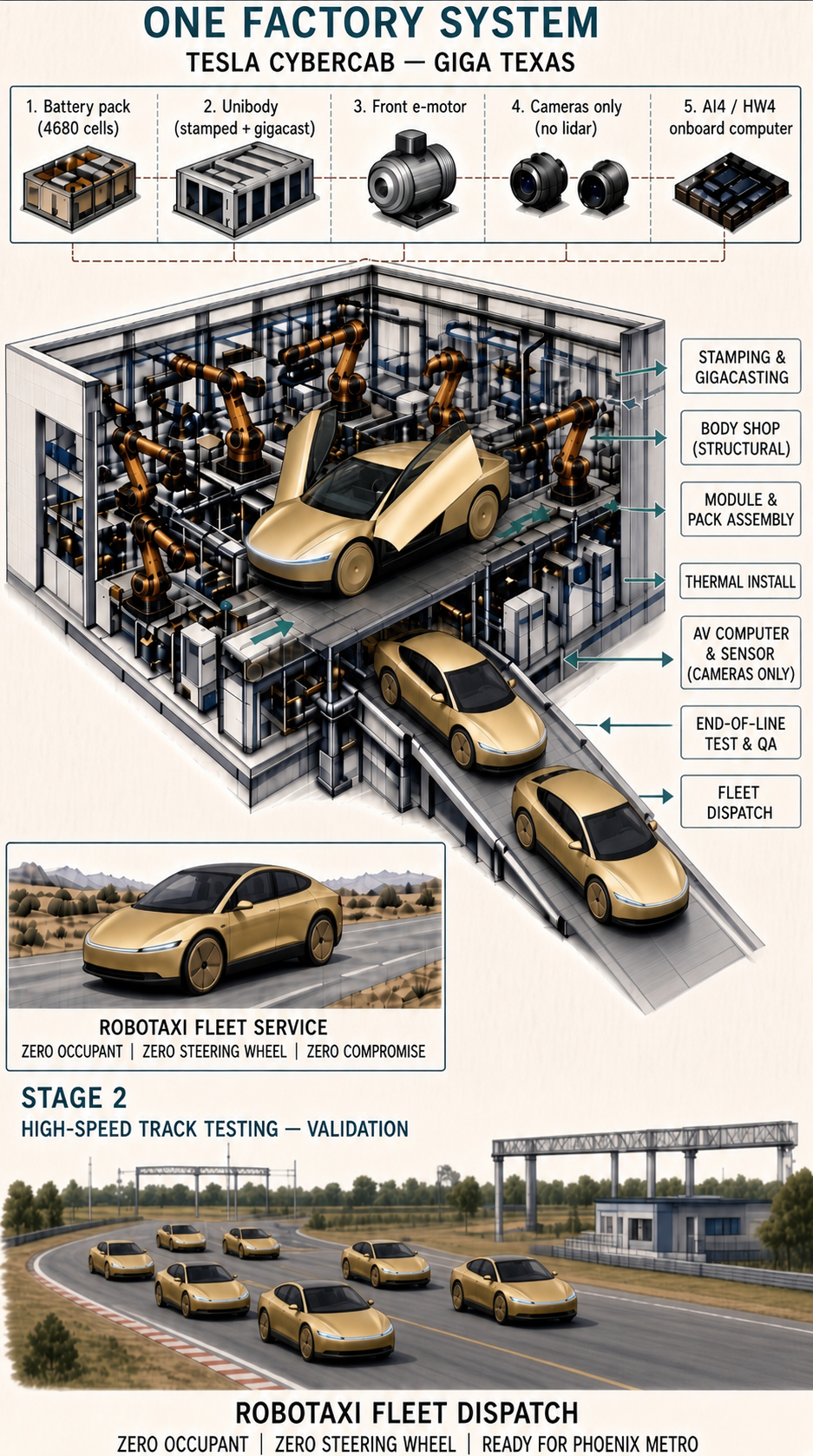
Process illustration, not a Tesla factory blueprint. It shows the manufacturing boundary this section explains; the component sequence and test stations are conceptual.
Tesla's 2025 10-K defines the economic contents of a delivered car more usefully than a parts diagram. Cost of automotive sales includes direct and indirect materials, labour, manufacturing overhead, tooling and machinery depreciation, shipping, logistics, tariffs, warranty reserves, ongoing FSD maintenance, connectivity and some Supercharging infrastructure. In other words, the manufacturing system does not stop at the factory door.
The physical flow is still recognisable:
- Cells and structural materials become a battery pack.
- Castings or stamped parts, closures and the body shop become a painted shell.
- Motors, power electronics, thermal systems, suspension and interior turn the shell into a car.
- Cameras, wiring and the onboard inference computer enter as production parts, not as a later autonomy conversion.
- Automated diagnostics and end-of-line checks test the assembled electrical, thermal, braking, steering, camera and compute systems as one vehicle. Dynamic validation then asks whether the complete car behaves correctly under load, rather than whether each part passed on its own.
- For Cybercab, Tesla finances and retains the vehicle, deploys it into its ride-hailing fleet and earns revenue when passengers pay fares.
That last factory test is distinct from proving autonomous driving on public roads. It can catch an assembly defect, a failed connection or a calibration problem; it cannot establish that the driving policy handles every road scene. Tesla's factory scale solves repetition. Safety evidence still has to come from validation outside the line.
That ownership model matters. Cybercab is not sold to a customer who finances the vehicle and may later add it to a network. Tesla funds the asset, keeps it on its balance sheet and places it into service; riders pay fares to use it. Manufacturing cost therefore becomes fleet capital employed, and Tesla must recover that investment through utilisation, fare revenue and the vehicle's useful life. A customer-owned Model Y may follow a different path, but it is not the vehicle illustrated or analysed here.
Tesla spent $56.267 billion on automotive sales cost in 2025 and delivered 1,636,129 vehicles. Dividing the first by the second gives $34,390 per delivered vehicle. That is an accounting proxy, not a bill of materials: the numerator includes logistics, warranty, connectivity, software maintenance, tariffs and manufacturing credits, while the denominator mixes models and destinations. It is still the best disclosed answer to what Tesla's complete vehicle system cost at the scale it actually ran.
Cybercab is the relevant production denominator here. Its more-than-125,000-unit annual line works out to more than 340 cars a day at nameplate capacity. Tesla has not said the line is running at that rate. It is also increasing 4680-cell output in Texas to support the Cybercab, Semi and Model Y ramps, while expanding the Austin-area autonomy infrastructure around the car.
What it takes to make one Waymo
Waymo manufactures a different object: not the base car, but the Waymo Driver integrated into a base car.
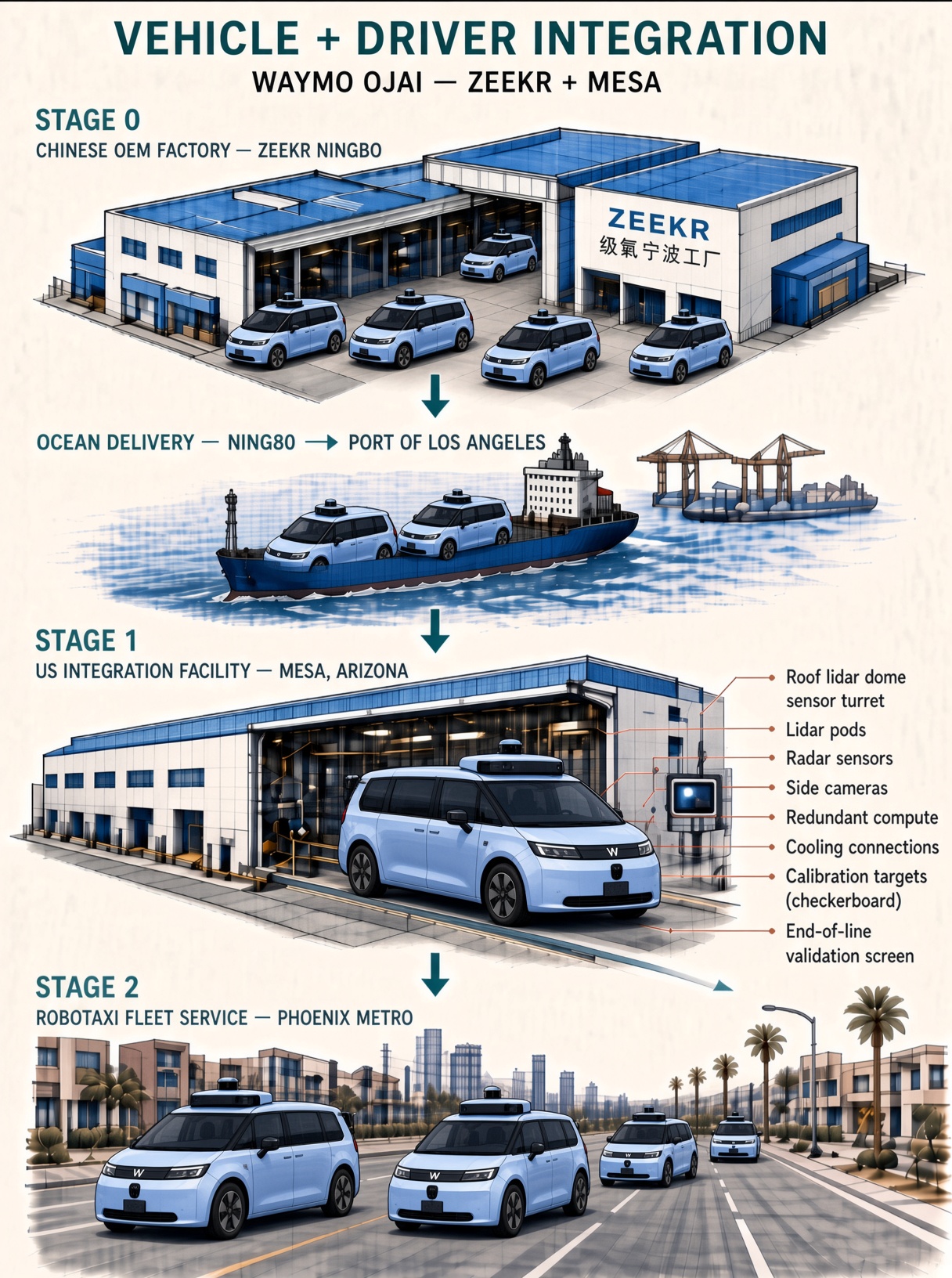
Process illustration, not a disclosed Waymo factory blueprint. The important fact is the split: vehicle production in China, followed by Driver integration and validation in Arizona.
For the Jaguar I-Pace fleet, Jaguar built and delivered the vehicle; Waymo and manufacturing partner Magna added the fifth-generation Driver in Mesa. For the Ojai, the vehicle platform comes from Zeekr's factory in Ningbo, China, crosses the Pacific and receives the sixth-generation Driver in the same Arizona operation. Waymo says the facility is designed to run multiple vehicle platforms at once, with an automated assembly line added as volume grows.
The second pass contains work a normal vehicle factory does not perform:
- Mount a surround sensor suite with overlapping fields of view: 13 cameras, four lidar, six radar and external audio receivers on the sixth generation. The audio receivers are part of the driving sensor suite: they help the vehicle perceive external cues rather than serving as factory test gear.
- Install the heterogeneous compute system. Waymo describes two independent engines running full parallel workloads so either can take over after a fault.
- Connect the Driver to vehicle power, controls, networking, liquid cooling and sensor-cleaning systems.
- Calibrate every sensor to the vehicle and every sensor to the others. A millimetre of mounting variation is a software input, not a cosmetic defect.
- Validate the integrated system, commission it for driverless operation and assign it to a service fleet.
Waymo has compressed the last step impressively. A Phoenix-bound vehicle can pick up its first public passenger less than 30 minutes after leaving the Mesa factory; vehicles shipped to other cities can enter service within hours of reaching a local depot. That removes launch delay. It does not remove the OEM factory or the Driver-integration line that came before it.
This distinction also explains why calling Waymo a "software company" misses the hard part. Its software is inseparable from automotive-qualified sensors, duplicated compute, thermal management, calibration rigs, depots, charging and fleet operations. The Driver is software expressed through an industrial system.
The border matters as much as the second factory. A third-party analysis of US import declarations put the Zeekr chassis at $38,000–$38,500 ex-factory and the tariff at 102.5%, implying a landed chassis near $78,000 before Waymo adds sensors, compute, integration and commissioning. Those are third-party estimates, not Waymo disclosures, and ocean freight and handling add another logistics layer. We set out the full cost build-up and its limits separately. The useful comparison is the sequence: China-built vehicle → ocean freight and import duty → Mesa integration → calibration and fleet commissioning. Tesla's sequence stays inside one domestic vehicle programme.
Cost: one finished product against a finished product plus a second system
Tesla discloses enough to calculate the $34,390 accounting-cost proxy above. Waymo discloses no comparable total cost, no Driver bill of materials and no depreciation schedule per vehicle. The $78,000 landed-chassis estimate above gives the comparison a boundary, not a company-reported cost. This is where most comparisons quietly invent a number. We are not going to.
The direction is knowable even when the amount is not. A Waymo has to pay for:
- the completed OEM vehicle;
- the Driver sensors, compute, wiring, thermal and cleaning hardware;
- a second integration and calibration process;
- the inventory and logistics between both factories;
- commissioning, fleet depots, charging and maintenance; and
- ownership of the vehicle while it waits, drives empty or earns a fare.
A Tesla customer car bundles its cameras and computer into the first factory pass and transfers the vehicle capital to the buyer. A Tesla-operated Cybercab does not get that last advantage — Tesla has to fund and depreciate it just as Waymo funds a fleet vehicle — but it still avoids buying a finished third-party car and converting it downstream.
This is why Waymo's sixth generation can be dramatically cheaper than its fifth and remain more expensive to manufacture than a Tesla. Waymo reduced sensor count and built a custom 5nm front-end ASIC; those are genuine cost improvements. They optimise the added Driver system. They do not make the underlying vehicle free. We separated the reported Driver-cost estimates from the cost of the complete Waymo vehicle when the custom chip was announced.
Tesla faces the opposite cost risk. Its low hardware content is only an advantage if that hardware is sufficient for unsupervised operation. If a deployed generation needs a new sensor, more compute or a redundant actuation path that cannot be delivered in software, the cheapest retrofit is no retrofit at all: build a newer car and strand the autonomy claim on older hardware.
Scalability: throughput is the easy half
The purpose-built production comparison now has two disclosed capacity ranges. Tesla lists more than 125,000 Cybercabs a year of installed capacity at Giga Texas. Waymo is scaling its Mesa integration factory toward tens of thousands of Waymo-enabled vehicles a year. Neither figure is a current run rate. The defensible comparison is simply that Tesla has disclosed a six-figure nameplate while Waymo describes a five-figure range.
That does not mean Tesla can switch on a million robotaxis. Manufacturing capacity, autonomous readiness, regulatory approval, fleet operations and passenger demand are separate gates. Tesla's factories clear only the first. Waymo has cleared the full chain in the cities where it operates, but at a much smaller manufacturing rate.
The contrast is easiest to state as two bottlenecks:
- Tesla is deployment-limited before it is factory-limited. Cybercab rides remain limited to parts of Austin even as Tesla expands the city's unsupervised operating area and ramps unsupervised Model Y service in Dallas and Houston.
- Waymo is integration- and deployment-limited after the base vehicle already exists. Its Driver works without a human in multiple cities, but every incremental fleet unit still has to pass through the second factory and then enter a local operating system.
Waymo's platform strategy partly compensates. The same Driver can move from Jaguar to Ojai and future OEM vehicles, so Waymo does not need to become a full carmaker. That converts factory ownership into interface work: every platform needs mechanical, electrical, thermal, control and safety integration. Multi-platform flexibility is real, but it is not free interchangeability.
Tesla makes the mirror-image trade. Deep integration removes interfaces and can cut parts and assembly steps, but changing the vehicle platform, inference computer or factory process becomes one coupled programme. The Model Y factory can ramp with extraordinary speed because Tesla controls the stack. A mistake can also propagate across a very large homogeneous fleet.
Improvement over time: software cadence versus hardware cadence
Both companies improve driving software from fleet experience. Tesla trains on data from a global fleet of millions of customer vehicles and ships eligible improvements over the air. Waymo says knowledge transfers across its fleet and even across hardware generations; that reuse helped the sixth generation reach driverless readiness in about half the time.
The manufacturing architecture determines what each can change cheaply.
| Change | Tesla | Waymo |
|---|---|---|
| Driving model | Fleet OTA update | Fleet software release |
| Sensor behaviour | Software, within installed hardware | Software, within installed hardware |
| New sensor | New vehicle revision; retrofit uncertain | New Driver generation and integration |
| More compute | New computer generation; compatibility gate | New Driver computer; platform validation |
| New vehicle body | Tesla factory and programme | New OEM platform plus integration programme |
| City expansion | Approval and operations | Validation, approval, depot and fleet |
Software compounds quickly inside a compatible hardware envelope. Hardware improves in batches. Tesla makes a larger bet on the envelope lasting: fewer sensing modalities, a simpler vehicle bill of materials and a vast installed fleet. Waymo makes a larger bet on changing the envelope safely: multiple modalities, explicit redundancy and a Driver designed to cross vehicle platforms.
Neither architecture escapes ageing. An over-the-air release cannot add lidar to a Tesla, enlarge its computer or duplicate a missing physical path. Shared Waymo learning cannot install a sixth-generation sensor on a fifth-generation Jaguar. In both systems, the cheapest code change rides on top of the most expensive earlier decision: what was frozen into the vehicle.
We examined the chips themselves separately. The manufacturing implication is simpler than the semiconductor comparison. Tesla tries to amortise custom hardware over a car business measured in millions. Waymo amortises more specialised hardware over a fleet measured in thousands today and, eventually, tens of thousands a year.
What the models say
Our Tesla model does not treat vehicle output as the near-term robotaxi constraint. It starts with 1,000 vehicles in commercial service, holds that fleet through the third quarter of 2026 and then assumes 600 additions a quarter with 22% quarterly growth in additions. Against factories capable of building millions, that ramp is small. The load-bearing variables are approval and utilisation: the model moves from 45% utilisation toward 72%, and the robotaxi line begins with capital expenditure at 120% of revenue because Tesla must buy the fleet before it earns.
Alphabet's model refuses to create a separate Waymo revenue line. Alphabet reported $382 million of second-quarter 2026 revenue and a $1.799 billion operating loss for all Other Bets, not Waymo alone. Waymo's ride count is disclosed; revenue per ride, fleet cost and vehicle depreciation are not. Turning rides into a valuation would require inventing the precise numbers this manufacturing comparison shows are missing.
That asymmetry is itself useful. Tesla gives investors factory capacity and full-company vehicle economics before it proves broad driverless deployment. Waymo gives investors driverless miles, rides and integration capacity without standalone economics. Each company discloses the side of the problem it has already solved.
What to watch
- Cybercab's actual run rate against its nameplate. Tesla now lists more than 125,000 units of installed annual capacity, but explicitly says installed capacity is not the current production rate. Quarterly Cybercab output is the missing denominator.
- Waymo's Mesa run rate. “Tens of thousands” is capacity language; annual integrations and fleet additions will show utilisation of that capacity.
- Complete vehicle cost. Driver hardware alone cannot settle the comparison. Waymo would need to disclose the base vehicle, integration, commissioning and depreciation together.
- Hardware compatibility. The share of Tesla's installed fleet eligible for unsupervised operation, and the service life of Waymo's fifth generation beside its sixth, will reveal the cost of iteration.
- Fleet utilisation. Manufacturing creates an asset; paid passenger time pays for it. Empty miles, charging time and depot time decide whether the cheaper car is the cheaper ride.
Manufacturing is not the verdict on which system drives better. It is the mechanism that decides how fast a system that works can become common, what every revision costs and how much old hardware is left behind. Tesla has already built the machine for millions of cars and still has to prove the driver. Waymo has proved the driver in service and is now building the machine for tens of thousands. The race is not only to autonomy. It is to make autonomy manufacturable.
Sources and provenance. Tesla's 2025 production, deliveries and automotive sales cost are company disclosures in its fourth-quarter release and 10-K; the $34,390 figure is R40 arithmetic and is an accounting proxy, not a bill of materials. Tesla's 9.7 million cumulative deliveries, Cybercab production start, more-than-125,000-unit installed annual capacity, Austin expansion and Texas 4680 ramp are from its Q2 2026 update; installed capacity is not represented as current output. Waymo's fleet, Mesa capacity, integration process, end-of-line timing and sixth-generation sensor counts are company disclosures. The two process illustrations are explanatory and are not factory blueprints. The $38,000–$38,500 Zeekr value, 102.5% tariff and roughly $78,000 landed chassis come from third-party analysis of US import declarations, as detailed in the linked cost article; Waymo has not disclosed them. Tesla robotaxi assumptions and Alphabet model treatment are R40 estimates; Alphabet's Other Bets figures are reported, but Waymo does not disclose standalone revenue, vehicle cost or depreciation. No undisclosed Waymo cost is treated as fact.