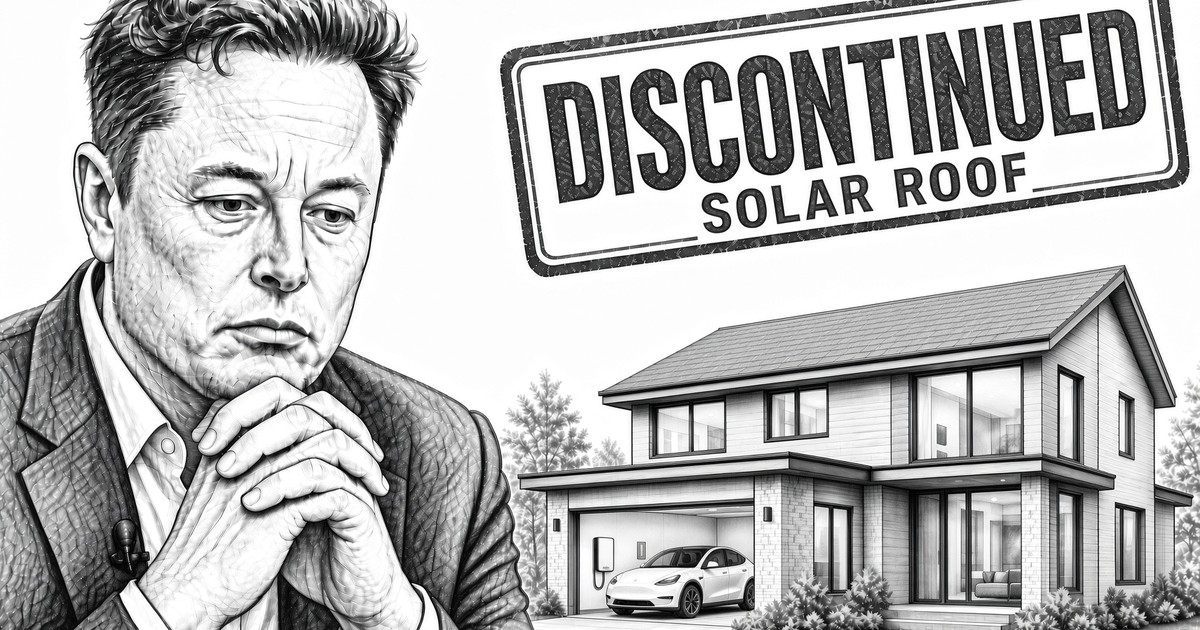
Tesla has told its certified third-party installers that Solar Roof tiles are no longer available to order, according to Electrek's August 20 report, which cites two sources close to the programme; one of them says Tesla concluded internally that the product was not financially viable. The same report says tesla.com/solarroof now redirects to the solar panels page and that Solar Roof has been dropped from the Energy navigation.
Tesla has said nothing. There is no press release, no filing language, and no shareholder-deck note. The website change is the strongest evidence in the record and we could not verify it ourselves: tesla.com returns a 403 to non-browser requests, and every recent Internet Archive capture of that page is a 403 as well. So the supportable statement today is that tiles have stopped reaching installers, on two unnamed sources and one outlet, and everything below is written against that rather than against a discontinuation Tesla has confirmed.
The coverage is reading this as an ending. It is more usefully read as a reorganisation of Tesla's home energy business into two manufactured products — a panel and a Powerwall — with the bespoke, install-heavy third product removed and a very large panel factory behind it. That framing is worth pricing. The ending is not.
The reorganisation is eight figures. Here is what each one is, and how firm it is:
- ~3,000 Solar Roof systems installed in the US over roughly seven years — Wood Mackenzie's estimate through early 2023, which Tesla called wrong "by a large margin" without publishing one of its own. It is still the only independent count anyone has.
- 1,000 a week was Musk's target, set in July 2019. Peak installation actually ran at 21 to 32 a week.
- Three weeks is that lifetime total at the promised rate. R40 arithmetic: 3,000 ÷ 1,000.
- No solar deployment line since 2024 Q1, when Tesla dropped it from quarterly reporting. Our Q2 2026 capture carries storage to the decimal and no solar figure at all.
- ~300 MW a year is Buffalo's reported module capacity, where the replacement TSP-420 panel has been assembled since its January 2026 launch. Press-reported; Tesla discloses nothing.
- 100 GW a year is the reported design target for the Brookshire, Texas plant — 333 times Buffalo, and on the same site as the 50 GWh Megapack 3 line that started production on August 6. It appears in no filing.
- $319M is our estimate of solar revenue in Q2 2026, 1.1% of Tesla's $28,236M quarter. Tesla reports one Energy segment and does not split solar out of it.
- $3.63 a share is what the entire solar vertical is worth in our model — $272.39 of base-case fair value with it, $268.76 without.
What is actually being retired
Three weeks of output is the headline version. The fuller one is worse: measured against the cumulative target from the 2019 announcement to Wood Mackenzie's early-2023 cut-off — call it 170 to 191 weeks — the product delivered 1.6% to 1.8% of what was promised. And that comparison is generous, because the 3,000 includes every roof installed before the target was ever set.
Now the part that bounds it. This is where a piece normally guesses at revenue; we are not going to, because Tesla has never disclosed Solar Roof pricing or volumes. What can be done is a ceiling that nothing can exceed:
32 systems a week — the top of the peak range, sustained for a full year — at $146,000, the largest single Solar Roof invoice in the public record (the quote that started at ~$72,000 and settled into a $6M class action) — is $243M a year.
That is a ceiling in three directions at once: the peak rate never held for a year, the $146,000 invoice was the outlier that produced litigation, and the arithmetic assumes both simultaneously. Against the trailing twelve months to 2026 Q2, the ceiling is 1.9% of the $12,799M Energy segment and 0.23% of Tesla's $103,619M of revenue. The real number is some fraction of that.
Tesla stopped publishing the figure two years before it stopped selling the product
Tesla dropped solar deployments from its quarterly reporting in 2024 Q1. Our own capture is the cleanest proof of what that costs a reader: the Q2 2026 numbers carry storage deployed of 13.5 GWh, up 41%, to the decimal — and no solar line at all. We can size the storage business by the gigawatt-hour and cannot size the solar business by anything, because the company stopped counting in public.
That is why every figure in this piece about the size of Tesla's solar business is labelled as our estimate. In our model, solar is carried as a separate vertical at $319M in 2026 Q2 and $1,249M across the trailing four quarters. It is an apportionment, not a disclosure: Tesla reports one Energy generation and storage segment, and our split of it into storage and solar sums to the reported $12,799M exactly, which makes it checkable but does not make it right.
What replaces it, and where
Three things changed before the tile stopped shipping, and together they are the reorganisation:
- A conventional panel Tesla makes itself. The TSP-420 launched commercially in January 2026, assembled at Gigafactory New York in Buffalo, with 18 power zones for shade tolerance and a rail-less mount. Cells are imported; the module is American.
- The channel changed. Tesla wound down its own installation crews and moved to certified third-party installers — which is why the discontinuation reached the market as an installer email rather than as a filing.
- A factory sized for something else entirely. Electrek reported in May that Tesla is building a vertically integrated solar plant — ingot, wafer, cell, module — in Brookshire, Texas, targeting 100 GW a year, with roughly $2.9B of equipment ordered and 1.65 million square feet leased.
The location is the tell. Brookshire is where Megafactory Texas is — the plant whose 50 GWh Megapack 3 line started production on August 6. Panels and grid batteries, one site, one supply chain, one construction programme. That is what a reorganisation looks like, and it is a far better explanation of the tile's retirement than a change of heart about solar.
It is also an enormous number, and it needs the same treatment as Musk's 1,000 a week did. 100 GW is 333 times Buffalo's reported ~300 MW of module capacity, and roughly 15% of the 647–664 GW the world installed in all of 2025. At the median US module assembly price of $0.30 a watt in mid-2026, 100 GW of output would be $30B of revenue a year — more than twice Tesla's entire Energy segment today, and about 24 times our estimate of its solar line. At $0.46 a watt, where modules with US-made cells were pricing in Q1 2026, it is $46B; at $0.265, the imported-module price, it is $26.5B.
None of those are forecasts. Tesla has given no volume target, no capex figure and no production date for Brookshire, and the 100 GW is a reported design target that appears in no filing. It is the size of the ambition, and the ambition is the only thing anyone has.
What it does to the model
Our Tesla model carries eight verticals against Tesla's three reported segments, and solar is one of them. Base case fair value is $272.39 a share, struck against the $405.05 price the model was last built on, as of August 16.
Delete the solar vertical entirely — every dollar of revenue, every dollar of capex, the whole line — and fair value falls to $268.76.
The entire solar business is worth $3.63 a share, or 1.3% of the base case. That is the answer to what the Solar Roof's retirement does to the valuation, and it is worth stating plainly: nothing that can happen to a $243M-ceiling product inside a line worth $3.63 is visible in this model at all.
Here is that against the things that do move it:
| Change from the base case | Fair value | Effect |
|---|---|---|
| Solar vertical removed entirely | $268.76 | −$3.63 |
| Solar growth flat at 3% a quarter forever | $271.57 | −$0.82 |
| Solar terminal growth 5.5% → 8% a quarter | $273.42 | +$1.03 |
| Storage deployment growth 6% → 7% a quarter | $279.29 | +$6.90 |
| Exit multiple 8.0x → 7.5x revenue | $256.14 | −$16.25 |
One point on the rate Tesla's storage deployments grow is worth almost twice the whole solar business. Half a turn of the exit multiple is worth 4.5 times it. This is the ordinary result for a line that is 1.6% of terminal revenue, and it is why the retirement of a product inside that line is a strategy story rather than an earnings one.
What Brookshire would be worth if it worked
The interesting question is the other direction. Our model glides solar to a terminal quarter of $755M, about $3.0B a year by 2031. The reported Brookshire target, at $0.30 a watt, is $30B a year — ten times what our model has solar reaching.
Set solar to compound at 17.1% a quarter for the full twenty-quarter horizon, which is what it takes to get from $319M to $7.5B a quarter, and fair value goes to $301.63. So:
- Solar as modelled: $3.63 a share.
- Solar at the announced factory's capacity, sold at the current median US module price: $29.24 a share, or 10.7% of the base case.
Eight times the value sits on the difference between a solar business that grows 3% a quarter and one that grows 17% a quarter for five straight years. Tesla's solar line has grown at roughly 3% a quarter for years. The gap between those two numbers is the whole Brookshire bet, and there is no disclosure anywhere that lets a reader narrow it.
One honest note about our own inputs. The model's solar thesis is built on a "$10B vertically integrated Texas cell plant" reaching commercial production in 2029 Q1 — which is close to the reported Brookshire programme but not the same shape as it: the reported figures are $2.9B of equipment and $250M of facility capex against a 100 GW target, on a timeline nearer 2028. If the reported plan is the real one, our solar vertical's driver is wrong — too slow, too small, and pointed at the wrong date. Changing it is a model revision and a separate decision, not something this article does. It is flagged here because a reader of that page deserves to know it is under review.
What to watch
- A Tesla statement, in any form. A line in the Q3 2026 shareholder deck, a 10-Q disclosure, or a formal notice. Until one exists, the discontinuation rests on two unnamed sources and a redirect.
- Whether solar deployments return to the reporting. Tesla dropped the line in 2024 Q1. A company building a 100 GW plant has a reason to start publishing volumes again; a company quietly shrinking a segment does not.
- Any capex, volume or date for Brookshire from Tesla itself. The 100 GW is press-reported. The first company-sourced figure of any kind converts this from an ambition to a model input.
- The Energy segment's implied price per kWh. Energy revenue divided by GWh deployed was $233 in Q2 2026, and that blend includes solar. As solar changes shape, the blend moves for reasons that have nothing to do with Megapack pricing — which is the trap our Megapack estimate already flagged.
- Whether the TSP panel gets a target at all. Musk gave the Solar Roof a number and missed it by 98%. The replacement has shipped for seven months without one.
The pattern is the finding, not the miss
A decade-old target missed by 98% is an easy story and not an especially useful one. The useful part is the sequence, because it has now happened twice in the same segment.
Announce a product with a weekly rate attached in 2016. Set the rate at 1,000 a week in 2019. Reach about 3,000 lifetime. Stop publishing the number in 2024. Ship a replacement in January 2026 with no number attached. Retire the original in August 2026 through an installer's inbox. And announce, in between, a plant sized at 100 GW a year — 333 times the capacity of the one currently running, and about a sixth of world demand — with no capex, no date and no volume target of its own.
The reorganisation is coherent. Two manufactured products instead of three, one Texas site for panels and batteries, third-party installers doing the labour. It is the right shape for a business that wants scale rather than bespoke roofs. What it does not yet have is a single number Tesla has put its own name to — and on this site, that is the difference between a strategy worth $3.63 a share and one worth $29.24.
Sources and provenance. The discontinuation, the installer notice, the website redirect, the "not financially viable" characterisation, the ~3,000 systems and 21–32 a week Wood Mackenzie estimates, the $146,000 invoice and the $6M class-action settlement are press-reported by Electrek, August 20, 2026 from two unnamed sources — Tesla has made no statement, and we could not verify the site change directly because tesla.com returns 403 to non-browser requests and recent Internet Archive captures of the page are 403s. Musk's 1,000-a-week target is his own, from July 2019. The TSP-420's January 2026 launch, Buffalo assembly, imported cells and ~300 MW module capacity are press-reported. The Brookshire 100 GW target, the $2.9B of equipment and the 1.65 million square feet are Electrek's May 19, 2026 exclusive and appear in no filing; Tesla has published no capex, date or volume target for the plant. Global 2025 installations of 647–664 GW are SolarPower Europe and PV Tech. US module prices of $0.265, $0.30, $0.36 and $0.46 a watt by domestic content are pv magazine USA's Q1 and mid-2026 assessments. Energy revenue of $3,139M, storage deployed of 13.5 GWh, total revenue of $28,236M and the absence of any solar line are disclosed, from Tesla's Q2 2026 8-K Exhibit 99.1 and our capture of it; the $12,799M and $103,619M trailing figures are derived from the same five-quarter table. The $319M and $1,249M solar figures, the $11,550M storage figures, the $272.39 base case, the $3.63, the $29.24 and every row of the sensitivity table are R40 model output, not Tesla numbers — the solar/storage split inside the Energy segment is our apportionment and Tesla discloses no such split. The $405.05 price is the snapshot the model was struck against on August 16 and is not a live price. The $243M Solar Roof ceiling is R40 arithmetic on the Wood Mackenzie peak rate and the largest invoice in the public record, and is a bound rather than an estimate.