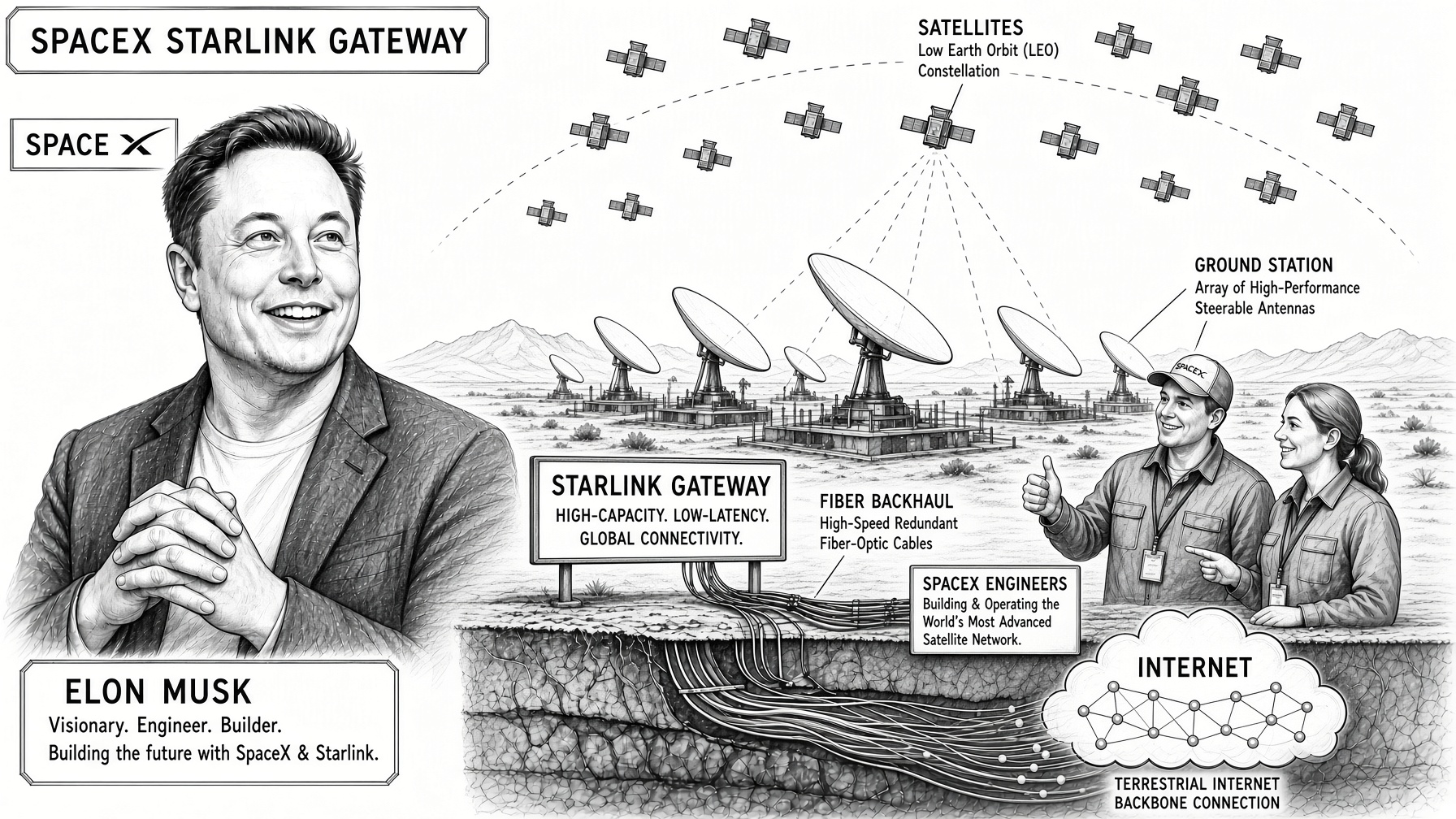
On April 23, 2026, SpaceX applied to the FCC for a new Starlink gateway at its own factory campus in Bastrop, Texas, filed under the name "First of Its Name." It is 40 antennas of 1.99-metre parabolic dish — larger than the roughly 1.85 m on existing sites — and it is the company's first gateway designed to operate across four bands: Ka, V, E and W, where existing sites are mainly Ka and E.
It is one of 28 gateway applications SpaceX currently has pending. Iridium has asked the FCC to block or condition all of them in two specific slices of Ka — 19.4–19.6 GHz and 29.1–29.3 GHz — which Iridium uses for its own feeder links, saying its simulations show interference at the nearest sites exceeding permitted levels by a wide margin. SpaceX's filings say its simulations show none. The matter is pending, and nothing below assumes an outcome.
Two weeks ago, in our piece on Starlink's share of internet traffic, we wrote that the constellation's capacity could already carry about 4% of the world's internet while its subscriber base implies it carries under 1%, and concluded: "Capacity is not the binding constraint. Customers are... the near-term ceiling is demand and ground segment, not satellites."
We named the ground segment and did not size it. This filing makes it sizable, so here it is.
The argument is seven figures. Here is what each one is, and how firm it is:
- 1,500+ antennas across 100+ US sites — press-reported, no SpaceX disclosure. Globally the trackers put sites at roughly 150 to 300+, operational and planned together, so the honest global antenna range is 2,000 to 4,500.
- 5 to 10 Gbps per gateway antenna — from third-party modelling and from Starlink's own Community and bonded gateway products, which are sold at up to 10 Gbps symmetric and up to 20 Gbps in a bonded configuration. SpaceX publishes no per-antenna figure.
- 12 million Starlink subscribers, disclosed with the Q2 2026 print, at a $66 blended monthly ARPU.
- 2,667 to 6,000 subscribers per gateway antenna — R40 arithmetic on the two ranges above. That is the number this piece exists to supply.
- $2.11M to $4.75M a year of Starlink revenue per antenna, at the disclosed ARPU.
- 45.7 million subscribers by 2031 Q2 — our model's base-case path, 3.8× today.
- $58.51 a share is what the Starlink vertical is worth in that model, of a $187.12 base case against $146.23 as of August 19. It is the largest single line in the model, at 28.3% of terminal revenue.
What a gateway antenna is worth
Every byte a Starlink customer receives from the internet enters the system through a gateway. Laser inter-satellite links move traffic around in orbit and reduce the need for a gateway under every user, but they do not create egress — the traffic still has to land somewhere and reach a fibre. Aggregate served throughput cannot exceed aggregate gateway throughput, which makes the ground segment a hard ceiling on the subscriber business rather than a logistics detail.
So divide the subscribers by the antennas:
| Low | High | |
|---|---|---|
| Global gateway antennas | 4,500 | 2,000 |
| Subscribers per antenna | 2,667 | 6,000 |
| Revenue per antenna, a year | $2.11M | $4.75M |
| Egress per subscriber, at 5–10 Gbps | 1.9–3.8 Mbps | 0.8–1.7 Mbps |
Both ends of that are ours, built on a press-reported antenna count and a third-party throughput estimate. Neither figure is disclosed by SpaceX, and this is exactly the place where analysis normally picks a point estimate and presents it as known. We are not going to. The range is the finding, and it is narrow enough to be useful: a Starlink gateway antenna carries a few thousand subscribers and a few million dollars a year.
Apply it to the filing. Bastrop's 40 antennas are $84M to $190M a year of Starlink revenue capacity at today's subscriber density — call it 0.4% of a quarter's revenue at the midpoint. One gateway is not a material event. That is the point of doing the arithmetic: it establishes the unit, and the unit is what the growth story has to be multiplied by.
The per-subscriber egress line is the one to keep. At the density above, each subscriber has between roughly 0.8 and 3.8 Mbps of ground egress available on average. That is an ordinary ISP oversubscription ratio against a service advertising 100–200 Mbps peaks — not alarming, and not slack either. It is a system running at the tightness you would expect of one that is about to be upgraded.
What our model's subscriber path costs in antennas
The model takes Starlink from 12.0 million subscribers to 45.7 million by 2031 Q2 — net adds gliding from 1.5 million a quarter toward a 2.6 million ceiling, against a 130 million-household addressable base. Holding subscribers-per-antenna constant, here is what that path implies for the ground segment:
| Subscribers (R40 model) | Antennas needed |
|---|---|
| 2026 Q4 — 15.0M | 2,500 – 5,600 |
| 2027 Q4 — 21.6M | 3,600 – 8,100 |
| 2028 Q4 — 28.6M | 4,800 – 10,700 |
| 2029 Q4 — 35.6M | 5,900 – 13,300 |
| 2031 Q2 — 45.7M | 7,600 – 17,100 |
Against 2,000 to 4,500 today, that is 5,600 to 12,600 new gateway antennas in five years — the equivalent of 140 to 316 Bastrop-sized sites, or 28 to 63 of them a year.
Now set that against the pipeline. 28 applications are pending. If every one were a 40-antenna Bastrop, they would add 1,120 antennas, enough for 3.0 to 6.7 million subscribers — against the 33.7 million of net additions the model projects. The entire pending pipeline covers 9% to 20% of the growth our own model already assumes, and it represents roughly one year of the required build rate, not five.
Two honest caveats, both of which cut the same way as the headline rather than against it. The 28 applications are the ones Iridium named, not necessarily every application SpaceX has filed. And a gateway site does not have to be 40 antennas — most existing ones average about fifteen.
Why the answer is bands, not sites
The reason this is a story about spectrum rather than about concrete is that SpaceX is not proposing to solve a 12,000-antenna problem by building 12,000 antennas.
The Bastrop design does two things at once. The dish grows from ~1.85 m to 1.99 m, which lets one antenna hold more satellites at once. And the site adds V, E and W to Ka, which multiplies the bandwidth each antenna can use. A gateway antenna's Ka allocation is roughly 2 GHz of uplink and 1.25 GHz of downlink; adding three more bands is a capacity multiple per antenna, not an increment.
That is the whole strategy: raise throughput per site fast enough that the site count does not have to follow the subscriber count. If it works, the 140-to-316-sites figure above is wrong and too high — which is the outcome the model implicitly assumes, since the model has no ground-segment constraint in it at all.
And it is what makes the Iridium objection load-bearing rather than procedural. The disputed 19.4–19.6 and 29.1–29.3 GHz slices are 400 MHz in total — about 16% of a gateway antenna's Ka downlink allocation and 10% of its uplink. Losing them at some sites would not stop the programme. It would lower the multiplier at exactly the moment the multiplier is what the plan rests on, and it would do so across 28 sites simultaneously.
What the model says, and what it does not carry
Base case fair value is $187.12 against $146.23 as of August 19.
| Change from the base case | Fair value | Effect |
|---|---|---|
| Starlink vertical removed entirely | $128.62 | −$58.51 |
| Non-subscriber revenue growth 9% → 7% a quarter | $176.82 | −$10.31 |
| Half a turn off the exit multiple | $182.32 | −$4.80 |
| Net adds ceiling 2.6M → 1.5M a quarter | $182.83 | −$4.29 |
| Net adds ceiling 2.6M → 2.0M a quarter | $184.83 | −$2.29 |
| Net adds ceiling 2.6M → 3.5M a quarter | $190.37 | +$3.25 |
Read the last three rows together, because they are where a ground-segment constraint would actually show up. The model's driver note says plainly that "terminals and satellite capacity, not demand, are the binding constraint" on net adds. That sentence is ours, it is an assumption, and this filing is the first piece of evidence that it may name the wrong constraint — the third candidate, ground egress, is not in the model as a variable at all.
The size of the exposure is smaller than the drama suggests. If the ground segment caps net adds at today's 1.5 million a quarter forever instead of letting them grow to 2.6 million, the cost is $4.29 a share — less than one turn of the exit multiple. Starlink is worth $58.51 in this model; the growth rate of its net adds is worth about 7% of that, because a subscription line's value sits mostly in the base and the terminal multiple rather than in the second derivative of adds.
So the honest conclusion is not that the gateway build threatens the thesis. It is that the gateway build is the mechanism by which the model's subscriber assumption is either honoured or quietly missed, and the model contains no term for it. We are not adding one on the strength of a licence application. A ground-egress variable would need a disclosed antenna count or a run of quarters where net adds visibly stall, and neither exists yet — until one does, the constraint is priced where the table above prices it, in the net adds ceiling.
What to watch
- The FCC's disposition of the 28 applications, and specifically whether the 19.4–19.6 and 29.1–29.3 GHz authority survives, is conditioned by geography, or is stripped. That is the multiplier, at 28 sites at once.
- Whether any subsequent filing matches Bastrop's 40 antennas. "First of Its Name" is a one-site design until a second one is filed. A run of 40-antenna quad-band applications is the signal that the site count genuinely does not have to follow the subscriber count.
- A disclosed gateway or antenna count from SpaceX. Every ground-segment figure in this piece is press-reported or third-party. A single number in a shareholder letter would replace a 2.25× range with a fact.
- Net adds against 1.5 million a quarter. The model glides them up to 2.6 million. Four consecutive quarters flat at 1.5 million would be the observable form of a ground constraint, and it is worth $4.29 a share.
- V3 deployment against gateway readiness. V3 is specified at roughly 1 Tbps of downlink per satellite. A constellation whose space-side capacity outruns its egress by an order of magnitude does not convert the difference into revenue — it converts it into headroom, and headroom does not pay ARPU.
The ground segment is the half nobody prices
The Starlink argument on the timeline is almost always about satellites: how many, how big, how fast, launched how often. We have written that piece too, this morning.
The gateway filings are the other half, and they are duller and more checkable. A satellite target is a claim about 2030. A gateway application has a date, a location, an antenna count, a dish diameter, a band list and a named opponent — and it resolves in months rather than years.
On our own numbers the ground segment is running at a few thousand subscribers and a few million dollars an antenna, the pending pipeline covers a fifth of the growth we already assume at best, and the plan for closing that gap is 400 MHz of spectrum that another operator is formally contesting. None of that is fatal to a $58.51-a-share vertical. All of it is more concrete than anything on the satellite side of the story.
Sources and provenance. The Bastrop "First of Its Name" application of April 23, 2026 — 40 antennas, 1.99 m dishes against ~1.85 m on prior sites, Ka+V+E+W quad-band, at Starlink's Bastrop factory campus — is press-reported from the FCC filing. Iridium's request that the FCC block or condition use of 19.4–19.6 GHz and 29.1–29.3 GHz across 28 pending SpaceX gateway applications, its interference simulations, and SpaceX's contrary simulations are press-reported from the parties' own FCC filings; the proceeding is pending and no outcome is assumed here. The 100+ US gateway sites, 1,500+ US antennas, the 150–300+ global site range, and the Community and bonded gateway throughputs of 10 Gbps symmetric and up to 20 Gbps bonded are press-reported and vendor-published; SpaceX discloses no gateway or antenna count. The 5–10 Gbps per antenna and the 4×500 MHz uplink / 5×250 MHz downlink channel allocation are third-party modelling, not company figures. The 12 million subscribers and $66 ARPU are disclosed with the Q2 2026 print. V3's ~1 Tbps downlink and the 450 Tbps constellation capacity estimate are carried over from our August 5 traffic piece, where their provenance is set out. The 2,667–6,000 subscribers per antenna, the $2.11M–$4.75M per antenna, the $84M–$190M for Bastrop, the antenna requirements at every subscriber level, the 140–316 sites, the 9%–20% pipeline coverage and the 16%/10% spectrum shares are R40 arithmetic on the figures above, and they inherit every range in them. The 45.7 million subscriber path, the $187.12 base case, the $58.51 Starlink contribution and every row of the sensitivity table are R40 model output on the assumptions published in our SPCX model — our estimates, not SpaceX figures. The $146.23 price is the snapshot the model was struck against on August 19 and is not a live price.
