The easiest way to misunderstand the AI power trade is to put Tesla Megapack and Bloom Energy Server in the same product category.
They are not.
A Tesla Megapack is a large battery. It can absorb electricity, store it, and return it almost instantly. It can smooth the violent swings of a synchronized GPU cluster, support voltage and frequency, help a datacenter ride through a grid fault, shift demand away from a constrained hour, and provide backup power. What it cannot do is create net new energy. Every megawatt-hour discharged has to be charged from the grid, a solar field, a wind farm, a gas plant, a fuel cell, or some other generator.
A Bloom Energy Server is a generator. It converts the chemical energy in natural gas into electricity through a high-temperature electrochemical process rather than combustion. As long as fuel continues to arrive, it can produce electricity around the clock. What it cannot do as well as a battery is react instantaneously to every millisecond-scale jump in a cluster's demand or store surplus electricity for later.
That difference explains the two strategies.
SpaceXAI's terrestrial compute buildout uses a power stack: utility supply and gas turbines provide energy; Tesla Megapacks stabilize the system and shift energy through time. Bloom's pitch is to move a modular, onsite generator much closer to the servers, reducing dependence on both the grid timetable and conventional combustion equipment. The first strategy optimizes a mixed system. The second tries to replace one of its most difficult layers.
The products overlap at the edges, but they are more complementary than competitive. A useful comparison therefore has to begin with the entire datacenter power system—not with two ticker symbols.
First Principles: Power Is Not Energy
Datacenter discussions routinely mix megawatts and megawatt-hours, which makes a battery sound more like a power plant than it is.
- A megawatt (MW) measures the rate at which power is produced or consumed.
- A megawatt-hour (MWh) measures an amount of energy.
A 100MW datacenter running continuously consumes 100MWh every hour, 2,400MWh per day, and 876,000MWh per year before maintenance or load variation. A 100MW/200MWh battery can serve that full load for about two hours before losses and operating reserves. A 100MW generator can keep serving it as long as fuel, maintenance, and cooling allow.
That does not make the generator inherently more valuable. Two hours of precisely controlled electricity can prevent a multibillion-dollar GPU cluster from tripping, avoid a utility peak, bridge a fault, or allow a constrained interconnection to serve a larger campus. It means the value of storage comes from when and how fast it supplies energy, not from pretending its duration is unlimited.
The Datacenter Power Menu
The industry is not choosing one universal solution. It is assembling different combinations around local constraints.
| Approach | What it supplies | Advantages | Limitations |
|---|---|---|---|
| Utility grid | Bulk electricity from a regional portfolio | Usually the simplest operating model; access to diverse generation | Multi-year interconnection queues, transmission constraints, exposure to grid faults and tariffs |
| Gas turbines and engines | Firm onsite generation | High power density, dispatchable, familiar technology | Air permits, noise, CO₂ and local pollutants; large-turbine lead times can be years |
| Solid-oxide fuel cells | Firm onsite generation from natural gas | Modular, quiet, low local criteria pollutants, potentially faster permitting | Still emits CO₂; requires a fuel connection; manufacturing scale and lifecycle cost matter |
| Battery storage | Fast stored power and control | Millisecond response, load smoothing, ride-through, backup, peak shifting | Does not generate energy; finite duration; must recharge |
| Solar plus storage | Low-marginal-cost generation plus time shifting | Low operating emissions and modular deployment | Intermittency, land, weather, and very large storage requirements for 24/7 service |
| Nuclear | Firm low-carbon generation | High capacity factor and long asset life | Restarts and new builds take years; first-of-a-kind cost and regulatory risk |
| Diesel generators | Emergency generation | Proven, quick starting, widely available | Fuel logistics, noise, emissions, maintenance; generally unattractive as primary power |
The International Energy Agency expects global datacenter electricity consumption to rise from roughly 460TWh in 2024 to about 945TWh in 2030. It also estimates that grid constraints could delay around 20% of planned global datacenter capacity through 2030. This is why onsite power has shifted from a resilience feature to a construction strategy: a completed datacenter without an energized interconnection is an expensive warehouse.
The near-term mix is not especially mysterious. The IEA expects renewables to meet roughly half of additional global datacenter electricity demand through 2030, but natural gas and coal together still supply more than 40% of the increase. Nuclear becomes more material later. Batteries make all of those sources more usable; they do not replace their annual energy output.
A Datacenter Needs Four Power Layers
The cleanest framework is to separate four jobs.
1. Energy supply
Something must produce the MWh: the grid, a gas turbine, a Bloom fuel cell, solar, wind, hydro, geothermal, or nuclear. This layer determines whether the campus can run for days and years.
2. Capacity and time shifting
The site needs enough power during its highest-demand hours. Batteries can charge when energy is available and discharge when the grid, generator, or tariff is tight. Flexible computing can also shift workloads, but curtailing a frontier GPU cluster carries an enormous opportunity cost.
3. Power quality and transient response
GPU clusters are unusually difficult electrical loads. Synchronized training jobs can move between communication, memory, and computation phases together, causing rapid changes in demand. Those changes occur faster than many mechanical generators can follow. Batteries and power electronics can respond in milliseconds.
4. Resilience and restart
UPS systems protect servers during the first moments of a fault. Longer-duration batteries or generators carry the facility through an outage. Grid-forming inverters can establish voltage and frequency in a weak or islanded system and may assist black start, subject to system design and commissioning.
Tesla is strongest in layers two through four. Bloom starts in layer one and can participate in the resilient microgrid architecture around it. The comparison becomes coherent only after those roles are separated.
Tesla's Datacenter Product: A Battery With Power-System Software
Tesla's October 2025 paper, Megapack for Data Centers: Powering the Growth of AI Infrastructure, describes a Megapack 2 XL as a 2MW/4MWh unit. The paper emphasizes four datacenter applications:
- smoothing AI training loads;
- helping the facility ride through low-voltage events;
- enabling a more flexible grid connection;
- providing backup power.
The first is more important than it sounds. Tesla cites reported AI-training fluctuations ranging from slower second-scale changes to millisecond-scale movement, sometimes spanning most of the cluster's load. Its control approach combines measurement-based dispatch with grid-forming behavior and claims more than 70% reduction in high-frequency variability in the cited implementation.
Imagine a cluster suddenly dropping 15MW because thousands of accelerators reach the same synchronization barrier. A gas turbine cannot instantly reduce fuel, temperature, pressure, and shaft output without mechanical consequences. The Megapack can start charging and absorb much of the missing load. When the GPUs return to computation, the battery reverses direction. From the generator's perspective, the datacenter becomes calmer than the workload really is.
This is not energy arbitrage in the ordinary sense. The battery may charge and discharge around a relatively stable state of charge, moving modest amounts of energy but very large amounts of power back and forth. Its value is reduced generator stress, better frequency control, and fewer cluster interruptions.
The next product packages more of the site in the factory
The 2025 datacenter paper describes Megapack 2 XL because that was the shipping reference design. Tesla has since introduced Megapack 3 and Megablock, a pre-engineered medium-voltage system integrating four Megapack 3 units with more of the electrical architecture assembled before delivery. Tesla says production is scheduled to begin at its Houston-area Megafactory during 2026, with up to 50GWh of annual capacity.
For datacenters, the important change is not merely a larger battery. Factory integration moves transformers, switchgear, controls, testing, and interfaces out of bespoke field construction. That can reduce onsite labor and execution risk—the same industrial logic Bloom applies to repeating 325kW generator modules. In both cases, the vendor is trying to turn power infrastructure from a custom construction project into a manufactured product.
What Grid-Forming Actually Adds
Most inverter-based resources historically operated as grid-following devices. They observed an existing voltage waveform and injected current into it. A strong external grid or rotating generator established the reference.
A grid-forming inverter can behave more like a voltage source. Tesla's grid-forming primer describes control that can establish voltage and frequency, provide synthetic inertia and system strength, respond to added or rejected load, and support a weak or islanded network. In its datacenter paper, Tesla models recovery of utility draw in roughly 30 milliseconds after a fault under the stated assumptions.
This matters because an AI campus can be both a load and a small power system. If it has onsite turbines, solar, batteries, UPS equipment, and a constrained grid connection, those components have to remain synchronized through disturbances. A battery capable of forming the local electrical reference can make the microgrid more stable.
But grid-forming does not repeal energy conservation. Software can make stored power behave more like a machine; it cannot make a two-hour battery run a 24-hour outage without another source charging it. Grid-forming improves quality, control, and restart. It does not turn storage into fuel.
The SpaceXAI Example: Gas Makes the Energy, Megapacks Make It Usable
Tesla's datacenter paper identifies xAI's Colossus as a 200,000-GPU, roughly 250MW cluster using Megapacks for AI load smoothing and demand response. Following SpaceX's acquisition of xAI in February 2026, the combined company's offering materials went further: they described Colossus and Colossus II as providing approximately 1.0GW of compute power and called the installation the first gigawatt-scale Megapack battery system.
The word battery is essential. The energy behind the terrestrial cluster still comes from utility service and gas generation. SpaceXAI says the Southaven buildout currently uses 69 temporary mobile turbines and that a 1.2GW permanent plant with 41 turbines is under construction. Under its announced schedule, the temporary units begin leaving in August 2026 and are removed by July 2027 as permanent capacity comes online.
The resulting architecture is straightforward:
Grid and gas turbines supply the energy → Megapacks buffer the fluctuations → UPS and electrical distribution protect the servers.
That architecture optimizes for speed. SpaceX says the first Colossus cluster came online in 122 days and the first Colossus II cluster in 91 days, compared with its cited industry benchmark of roughly two years for a 100MW greenfield datacenter. The trade-off is that the fastest available firm generation has brought emissions, permitting, noise, and community controversy with it.
Tesla solar is not the primary power source in this system. Solar could reduce fuel consumption and recharge batteries when available, but a 1GW continuous load consumes 24GWh every day. Supplying that load through terrestrial solar alone would require several gigawatts of panels, substantial land, transmission within the site, and enough storage or other firm generation to bridge every night and weather event. SpaceX's longer-term prospectus discussion of near-continuous solar belongs to its proposed orbital compute strategy, not the present Memphis power stack.
Bloom's Product: Put the Power Plant Beside the Servers
Bloom Energy starts from the opposite end of the problem. Its Energy Server is a solid-oxide fuel cell system. Natural gas enters the unit; heat and a ceramic electrolyte enable an electrochemical reaction; electricity emerges as DC power before conversion or delivery into the site's electrical architecture.
There is no combustion flame driving a turbine. That distinction sharply reduces NOx, SOx, particulate emissions, noise, and mechanical complexity at the point of generation. It does not make natural-gas operation carbon-free. Carbon in the methane still leaves principally as CO₂, and upstream methane leakage remains part of the lifecycle footprint.
Bloom's February 2026 Energy Server 6.5 datasheet specifies:
- 325kW net AC nameplate output per Energy Server;
- cumulative electrical efficiency declining through a 65%–53% LHV range;
- no water consumption during normal operation;
- noise below 65dBA at ten feet;
- NOx of 0.003 pounds per MWh and negligible SOx;
- stated CO₂ emissions of 679–833 pounds per MWh;
- operation on natural gas, with customers directed to Bloom for biogas or hydrogen configurations.
The unit is modular. Roughly 308 nameplate 325kW servers equal 100MW before redundancy and site-level derating. A campus can energize one block while later blocks are still being installed, matching power construction more closely to datacenter phases.
Bloom markets delivery in as little as 90 days for some datacenter configurations. That is a company claim, not a universal project schedule: land, gas service, electrical equipment, local permits, financing, and construction can still dominate. The strategic point is that a factory-produced 325kW module is not waiting in the same multiyear queue as a large utility substation or heavy-duty turbine.
Why Bloom Can Win Where Turbines Struggle
Bloom's strongest argument is not that fuel-cell electricity is always cheapest. It is that time-to-power has economic value.
A 100MW AI facility can contain several billion dollars of accelerators and supporting infrastructure. If the grid will arrive in four years but onsite power can arrive in one, the relevant comparison is not merely cents per kWh. It is the cost of onsite electricity versus three years of foregone compute revenue and hardware obsolescence.
Fuel cells also address local permitting differently from combustion. Bloom's own specifications show extremely low criteria-pollutant emissions, and the systems are quieter than a turbine plant. That can matter in locations where NOx, noise, water, or community opposition is the binding constraint.
The commercial pipeline now reflects that demand. Oracle expanded its relationship with Bloom under a master services agreement covering up to 2.8GW. Brookfield increased a financing framework for Bloom-powered AI infrastructure from $5 billion to $25 billion. Bloom says it has deployed more than 1.5GW across more than 1,200 sites, though that installed base spans many industries rather than datacenters alone.
The financial evidence has also changed. Bloom reported Q2 2026 revenue of $1.07 billion, a 33.4% GAAP gross margin, and $182 million of operating income. That does not prove every announced gigawatt will ship, but it shows the AI power thesis has moved from a presentation into reported product revenue.
Bloom's Limits Are Different From Tesla's
Bloom solves duration but inherits a fuel system.
It still needs natural gas
A gas-constrained site is not automatically a Bloom site. Pipeline capacity, pressure, firm transport, and backup-fuel design can become their own interconnection project. Gas prices affect operating economics. Hydrogen compatibility is not the same thing as abundant low-cost hydrogen.
It still emits carbon
The absence of combustion greatly improves local criteria pollutants, but natural-gas fuel cells release CO₂. Buyers promising 24/7 carbon-free energy have to pair the system with biogas, low-carbon hydrogen, carbon accounting, carbon capture, or a later transition to cleaner generation. Each introduces cost or supply constraints.
Solid-oxide systems prefer steady operation
High-temperature fuel cells are naturally suited to baseload. They are not a substitute for the instantaneous response of a battery or UPS. A highly volatile GPU cluster can still benefit from storage between the Energy Servers and the load.
Manufacturing has to catch the orders
An agreement for “up to” 2.8GW is not 2.8GW of installed equipment or firm near-term revenue. Bloom must expand manufacturing, qualify suppliers, deliver electrical integration, commission sites, and maintain stacks over their lives. The gap between announced demand and shipped capacity is the central execution question.
Tesla's Limits Are the Mirror Image
Tesla solves response and flexibility but inherits an energy source.
Duration becomes expensive quickly
Four hours of storage is useful for peak shifting and flexible interconnection. It is not enough for a multi-day outage. Extending lithium-ion backup from two hours to twenty-four hours generally requires roughly twelve times as much stored energy, before reserves and losses.
The battery must recharge
If a site has insufficient grid or generation capacity on average, a battery cannot repair the deficit. It can hide a 100MW shortfall for two hours; it cannot hide it every hour of the year.
Cell supply, degradation, and safety matter
Frequent high-power cycling consumes battery life. Thermal management, fire protection, spacing, replacement assumptions, and warranty throughput shape the economics. Tesla's integration and field experience are advantages, but they do not remove electrochemistry.
Storage revenue is not datacenter generation revenue
Tesla deployed a record 13.5GWh of energy storage products in Q2 2026, across utility, commercial, and other customers. That is evidence of manufacturing scale. It should not be read as 13.5GW of new firm power for AI campuses.
Tesla Versus Bloom, Directly
Scale and Cost, Without Mixing the Units
The cleanest public comparison uses two different units because the products perform two different jobs. Bloom reports GW of generating capacity: the rate at which its installed fleet can continuously produce electricity while fuel is available. Tesla reports GWh of stored energy: the amount its batteries can discharge before they must recharge. Converting either figure into the other's unit requires a duration assumption.
| Metric | Bloom Energy Server | Tesla Megapack |
|---|---|---|
| Cumulative installed base | ~1.5GW deployed across more than 1,200 installations; datacenters are only a subset | More than 58GWh operating in 65+ countries |
| Recent volume and manufacturing scale | 2GW/year by the end of 2026 is the management target; the existing footprint is described as expandable toward 5GW/year | 46.7GWh deployed in 2025; Houston is designed for up to 50GWh/year, in addition to Lathrop and Shanghai |
| Indicative capital cost | Roughly $2,500–$5,500/kW, or $2.5–$5.5B/GW, for the equipment/system range; full turnkey installed cost including site work and gas interconnection more commonly lands around $4–$7B/GW | Roughly $200–$285/kWh, or about $200–$285M per GWh, before project-specific site work and financing |
| What “1GW” buys | Roughly $4–$7B turnkey buys 1GW of nameplate generating capacity that can keep producing while fuel is supplied, subject to availability and maintenance; qualifying federal tax credits can reduce net customer outlay | Roughly $0.8–$1.14B buys 1GW for four hours—4GWh of nameplate storage—before reserve, losses and site work; it must then recharge |
| Cost of extending the duration | Capital cost is driven mainly by the GW of generating power; running longer adds fuel and operating cost rather than another complete generator for every four hours | Storage cost scales with GWh: 1GW for 24 hours requires 24GWh, roughly $4.8–$6.84B at the cited equipment range, and still requires an external source to charge it |
| Ongoing electricity economics | Indicative delivered-power estimates span roughly $65–$140/MWh, driven heavily by gas, financing, utilization and incentives | Not a generation LCOE: economics depend on charging-energy cost, round-trip losses, cycling, degradation and the value of discharging at the right moment |
The installed-base figures are company disclosures, but they are not equivalent. Bloom's latest public description says it has deployed 1.5GW across more than 1,200 installations. Tesla says more than 58GWh is operational globally and separately reported 46.7GWh of storage deployments during 2025. Tesla says Megapack 3 production in Houston can reach up to 50GWh a year. Factory targets are not guarantees that every unit will be produced, delivered and commissioned.
The cost ranges are less firm. Public estimates mix equipment, engineering and construction, gas interconnection, electrical balance-of-plant, redundancy, financing and long-term service. For Bloom, $2.5–5.5B/GW is the indicative equipment/system range; $4–7B/GW is the more comparable turnkey range after including site work and gas interconnection. A federal investment tax credit of roughly 30–40% can materially reduce net customer outlay where a project and its cost basis qualify. These remain order-of-magnitude brackets, not quoted prices.
There is also a missing item if the Tesla column is meant to describe a functioning SpaceX-style datacenter rather than the Megapack product alone: the gas turbines that generate the electricity. SpaceX disclosed an $805M turbine purchase agreement through 2029 and a separate approximately $2.0B agreement for mobile gas turbines and related packages. The combined $2.805B is the best company-specific spending anchor, but it is a multi-year procurement commitment and is not identified as the cost of exactly one 1GW campus. SpaceXAI separately says its Southaven transition uses 69 temporary turbines and a 1.2GW permanent plant with 41 turbines.
For normalization, the comparison below therefore uses a broader market range of $1.5–3.0B per GW of installed gas-turbine generation. Solar is excluded: the terrestrial Colossus power stack operating today is gas generation plus utility supply and Megapacks, while the solar projects discussed publicly remain small relative to a 1GW continuous load and have no disclosed GW-scale SpaceX budget.
Three Numbers for a 1GW Datacenter
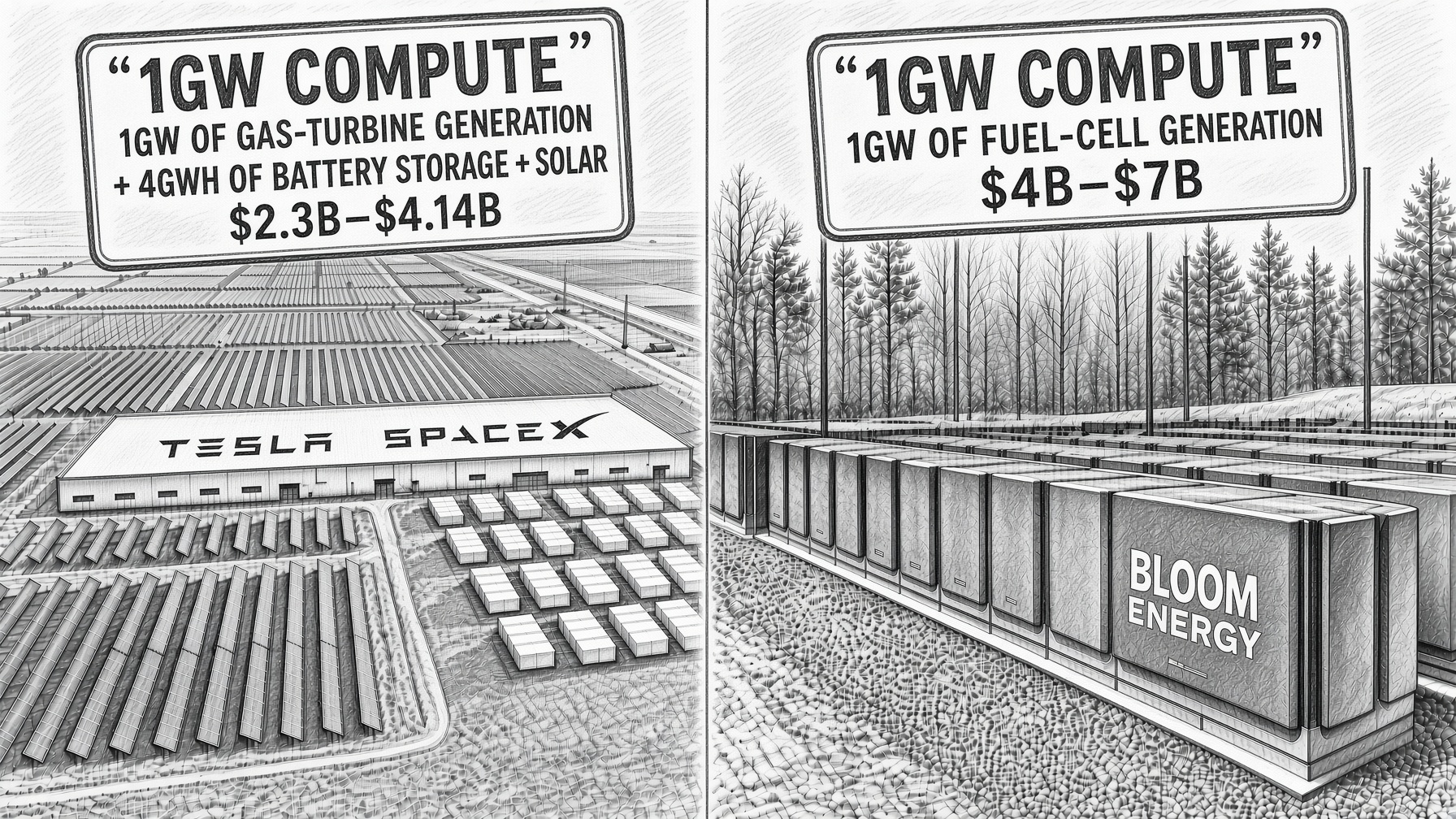
Assume a datacenter drawing a flat 1GW at the campus meter, 24 hours a day. It consumes 8.76TWh a year. The Tesla-side comparison now means the complete SpaceX-style gas-turbine-plus-Megapack stack, not a battery pretending to be a generator. Both columns are shown at 1GW nameplate before project-specific redundancy; the battery is four hours with 90% round-trip efficiency.
| Normalized figure | Bloom Energy Server | SpaceX-style gas + Tesla Megapack |
|---|---|---|
| Required capacity | 1GW of fuel-cell generation | 1GW of gas-turbine generation plus 1GW / 4GWh of battery storage |
| Indicative upfront cost | $4–$7B turnkey for generation, before project-specific redundancy and tax-credit effects | $1.5–$3.0B for turbines plus $0.8–$1.14B for storage: $2.3–$4.14B combined, before redundancy and site-specific work |
| Annual electricity supplied | Up to 8.76TWh of generated electricity at full output | Turbines generate up to 8.76TWh at full output; the battery can shift up to 1.46TWh of that electricity per year at one four-hour cycle per day |
The generation calculation is the same on both sides: 1GW × 8,760 hours = 8.76TWh a year at theoretical full output. Actual projects install redundancy and produce less during maintenance or curtailment. Bloom's comparable cost is the cited $4–7B per GW turnkey range, before any qualifying 30–40% federal investment tax credit. The SpaceX-style generation estimate is 1GW × $1,500–3,000/kW = $1.5–3.0B, consistent with SpaceX's disclosed $2.805B multi-year turbine commitment as a real-world anchor, though not a direct one-campus quote.
The Megapack calculation starts with duration: 1GW × 4 hours = 4GWh. At $200–285M/GWh, that costs 4 × $200–285M = $0.8–1.14B. Adding turbines produces the comparable stack cost: $1.5–3.0B + $0.8–1.14B = $2.3–4.14B. One complete battery discharge each day shifts 4GWh × 365 = 1.46TWh a year. At 90% round-trip efficiency, moving that energy through the battery requires 1.46TWh ÷ 90% = 1.62TWh of turbine or grid generation.
The comparable capital conclusion is therefore $4–7B turnkey for 1GW of Bloom generation versus approximately $2.3–4.14B for 1GW of gas-turbine generation plus four hours of Tesla storage, both before project-specific redundancy. The Bloom figure is also before any qualifying federal tax-credit benefit. The turbine stack may be cheaper upfront and faster to assemble, but it carries combustion emissions, fuel-price exposure, moving equipment, air permitting and potentially difficult turbine procurement. Bloom costs more before incentives but combines generation into a modular, quieter system with extremely low local criteria pollutants. The Megapack remains an additional resilience and power-quality layer, not the source of the 8.76TWh.
| Question | Tesla Megapack | Bloom Energy Server |
|---|---|---|
| What is sold? | Battery, inverter, controls, and energy software | Modular solid-oxide fuel-cell generator and service |
| Does it produce net new energy? | No | Yes, from supplied fuel |
| Best time scale | Milliseconds to hours | Continuous hours to years |
| Primary datacenter job | Smooth load, ride through faults, shift demand, provide backup | Supply onsite baseload and reduce grid dependence |
| Input | Electricity | Primarily natural gas today |
| Point-of-use emissions | None while discharging | CO₂ remains; very low stated NOx and SOx |
| Key physical limit | Stored MWh and recharge capacity | Fuel supply, stack life, and manufacturing capacity |
| Key permitting issue | Land, electrical, fire-safety, and interconnection approvals | Gas and electrical works; air treatment varies by jurisdiction but local pollutants are low |
| What it displaces most directly | Some UPS/generator runtime, grid upgrades, peaks, and power-quality equipment | Grid purchases or combustion-based primary generation |
| Does the other product still help? | Yes—Megapack needs generation | Yes—Bloom benefits from fast storage and UPS support |
The practical conclusion is not Tesla or Bloom. It is a sequence of architecture choices.
Which Architecture Wins?
Grid-rich market: grid plus batteries
Where utility power is available quickly and reliably, the lowest-complexity solution remains a strong grid connection, UPS, backup, and storage. Megapacks can improve the interconnection, smooth the AI load, and earn grid-service revenue. Bloom must beat an already-available utility on resilience, time, or total cost.
Grid-constrained but gas-rich market: onsite generation plus batteries
This is the present US AI buildout. Mobile turbines, reciprocating engines, permanent gas plants, or Bloom fuel cells produce energy. Batteries manage transients and peaks. The competition is mainly Bloom versus combustion for the generation layer; Tesla can sell into either outcome.
Emissions-constrained urban market: fuel cells gain an opening
Where noise and local air pollutants make a turbine plant difficult, Bloom's electrochemical process can be easier to site. It still has to clear carbon policy and obtain gas, but the community impact differs materially from dozens of combustion turbines.
Renewable-rich market: oversized generation plus storage
Solar and wind can supply low-cost energy, batteries can shift hours, and flexible computing can follow availability. Firm generation, long-duration storage, or a grid connection still has to cover prolonged deficits. The more continuous the required compute load, the larger that firm layer becomes.
Long-horizon low-carbon market: nuclear and geothermal
Nuclear restarts, new reactors, and advanced geothermal could eventually provide the firm low-carbon energy AI campuses want. They do not solve every 2026 interconnection. The IEA expects the first small modular reactors around 2030, making them a strategic supply source rather than the universal bridge for projects under construction today.
The Most Likely End State Is Hybrid
A mature AI campus may contain all of the following:
- a utility connection for economic energy and market participation;
- onsite fuel cells or turbines for firm capacity;
- solar or contracted renewables for lower-cost and lower-carbon MWh;
- Megapacks for load smoothing, peak shifting, and grid-forming control;
- UPS equipment for server-level ride-through;
- software deciding when to draw, generate, charge, discharge, or curtail flexible compute.
This is not redundant engineering. Each layer covers a different failure mode and time scale. A millisecond voltage event, a four-hour utility peak, a two-day storm, and a five-year interconnection delay are four different problems.
The system also creates an important commercial asymmetry. Tesla can participate regardless of whether the energy comes from the grid, gas turbines, Bloom servers, solar, or nuclear. Bloom wins only when the project chooses its technology for the generation layer—but that layer sells far more continuous energy capacity per site.
The Investor Question Is Capture, Not TAM
The datacenter power market can be enormous without every vendor capturing equal economics.
For Tesla, watch energy-storage deployment, factory utilization, gross margin, Megapack 3 and Megablock ramp, project mix, and the share of systems sold with higher-value software and services. The datacenter opportunity is additive to the utility-storage market, but headline GW of datacenter load should never be converted directly into Tesla battery GW. Required storage duration and architecture determine the addressable GWh.
For Bloom, watch actual system acceptances, manufacturing capacity, customer concentration, backlog conversion, service margins, stack performance, project finance, and the portion of “up to” agreements that becomes commissioned MW. A 2.8GW framework is strategically important; its revenue value depends on timing, pricing, financing structure, and delivery.
For SpaceX, Megapacks are an enabling input rather than the primary energy source. They can reduce construction time, improve cluster uptime, and protect turbines and GPUs. The economic value appears through faster time to useful compute and lower cost per token, not as an external energy product sold by SpaceX.
What Would Falsify Each Thesis?
The Tesla datacenter thesis weakens if utilities solve AI load variability without large batteries, if alternative storage wins on cost and control, or if datacenter customers require less duration and fewer MWh than expected. It strengthens if flexible interconnections, grid-forming requirements, and gas-plus-battery campuses become standard designs.
The Bloom thesis weakens if grid interconnection times collapse, turbine supply loosens, customers reject natural-gas carbon, manufacturing cannot meet large agreements, or lifecycle service costs erase the time-to-power advantage. It strengthens if onsite primary power becomes a default design and Bloom converts multi-GW frameworks into operating fleets on schedule.
The hybrid thesis weakens only if one technology becomes extraordinarily dominant across every time scale: cheap firm clean power with instant response, easy permitting, no fuel constraint, and rapid deployment. No commercial technology currently offers that combination.
What to Watch Through 2027
- SpaceXAI's removal of temporary turbines and commissioning of its permanent 1.2GW gas plant;
- the scale and operating role of the gigawatt-class Megapack installation at Colossus;
- Tesla's Megapack and Megablock manufacturing ramp and datacenter-specific orders;
- Bloom's deliveries under Oracle, Brookfield, and other large AI frameworks;
- evidence that fuel-cell projects repeatedly reach first power inside the promised schedule;
- gas-pipeline, electrical-equipment, and local permitting bottlenecks shifting from one layer to another;
- whether datacenter owners standardize on DC-native or tightly integrated architectures that reduce conversion losses between generation and server racks;
- actual cost per available MW, including delay, redundancy, fuel, maintenance, emissions controls, and financing—not only equipment capex.
Conclusion: The Battery Is Not the Power Plant
SpaceX's deployment demonstrates why Tesla Megapack matters. A gigawatt-scale AI cluster is not a smooth industrial load. It is a rapidly changing electrical machine whose value depends on keeping expensive accelerators synchronized and online. Fast storage makes a rough combination of grid and gas generation behave like a higher-quality power source.
Bloom Energy attacks the problem one layer earlier. Instead of accepting a slow grid or a combustion plant and then improving it, Bloom places modular generation onsite and converts pipeline fuel into continuous electricity with almost none of the local criteria pollutants of a turbine.
Neither product makes the other obsolete.
Megapack answers: How do we control, store, and stabilize the electricity we have?
Bloom answers: How do we produce reliable electricity before the grid is ready?
The AI power buildout needs both answers. The winning architecture will not be the one with the most fashionable source. It will be the one that delivers enough clean-enough energy, with millisecond stability and multiday resilience, before the GPUs become obsolete waiting for a substation.